
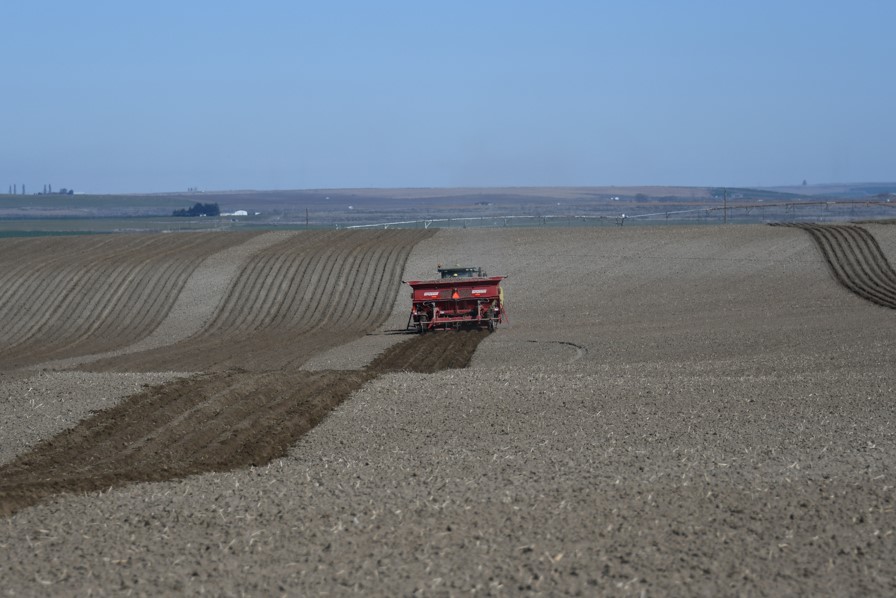
WHILE fields remain dormant at the start of the year, growers typically turn their attention to seed-lot selection, early chitting preparation and essential maintenance of equipment and stores.
But the nutritional foundations for a successful season ahead can also be laid. In fact, although planting is still some way off, the planning work done now can influence crop establishment, canopy development and tuber health.
Across the farm, winter provides the ideal window to review soil analyses, refine nutrition plans and map out rotations based on Potato cyst nematodes and disease pressures. With potatoes requiring balanced nutrition throughout their growth cycle, any nutrient limitation at critical development stages will impact final yield or quality.
Yara Agronomist Mark Tucker believes focusing on two key nutrients – phosphate in the early stages and calcium during tuber development – offers the greatest opportunity to secure crop performance and unlock significant improvements that deliver better returns for growers facing tight margins.
“Ensuring sufficient phosphate availability, right from the offset, is fundamental to unlocking maximum yield potential,” said Mark. “Phosphate plays a crucial role in shoot development and particularly root establishment. But the challenge farmers face is that phosphate is relatively immobile in soil, meaning roots must grow towards it rather than the nutrient moving through the soil profile.”
This presents an even greater issue for potatoes, which develop a relatively-poor root network in early stages and often struggle to establish an effective system capable of accessing water and nutrients efficiently.
Growers can improve phosphate management by using compound fertilisers such as YaraMila rather than traditional straight fertiliser applications, he said. Better timing of phosphorus and potassium applications will also ensure nutrients are available when the plant requires them, limiting the amount that becomes locked up in the soil.
“This is best achieved by applying phosphorus and potassium as compound fertiliser at or just after planting, rather than separate straight applications prior to planting,” Mark said. “Choosing a phosphate form which supplies readily available phosphorus whilst maintaining supply over time avoids lock-up problems.”
Lock-up occurs where available phosphate becomes bound in soil as either iron or aluminium phosphate at low pH, or as calcium phosphate at higher pH. Compound fertilisers containing phosphate in the form of P-Extend supply available phosphate over an extended period.
“We’d recommend YaraMila ACTYVA S at a rate of 525 – 650kg/ha to establish a good and healthy potato crop,” Mark said.
Better distribution of phosphate through the soil profile also aids plant uptake. The most effective approach is increasing the number of fertiliser particles. Traditionally, phosphate has been applied as relatively concentrated di-ammonium phosphate (DAP), containing 48% P₂O₅, resulting in relatively few concentrated particles.
However, applying phosphate as a compound fertiliser, such as YaraMila ACTYVA S, means every single prill or granule contains all nutrients. At a concentration of 14% P₂O₅, there will be approximately three times as many particles, dramatically improving distribution and availability.
Whilst phosphate sets up early crop development, growers should also begin to think about calcium, which is vital for tuber quality. Most aspects of quality can be enhanced by ensuring sufficient calcium supply during tuber growth, Mark said.
“Calcium is required for maintenance of cell walls and healthy leaf and tuber development,” he said. “Once calcium is incorporated into cell walls it can’t be redistributed, therefore it’s essential to have sufficient supply as new cells develop.”
Calcium deficiency manifests as internal rust spot where small brown spots, caused by cell death, appear in tubers. This relates directly to insufficient calcium within cell walls, meaning they aren’t strong enough. So that when cell expansion occurs, they collapse and necrosis develops.
As calcium is integral to cell walls, it gives cells, particularly the skin, strength. Therefore sufficient supply helps ensure good skin finish and protects against physical damage during harvesting and handling.
Trials have consistently demonstrated that calcium can improve tuber quality by controlling or reducing a range of disorders. Specifically, calcium has improved tuber skin finish by up to 70%, reduced bruising by around 40% and shown a 75% reduction of internal disorders such as internal rust spot.
But growers should also think about the calcium source being applied. There is a common misconception that liming materials will contain and provide enough calcium for the crop, but many liming materials are calcium carbonate based. This means they aren’t very water-soluble and consequently not freely available to the potato crop throughout the growing season.
“The ideal source of fully soluble calcium is YaraLiva Tropicote, which should be applied at tuber initiation,” Mark said. “However, the timing of application is also key, to flush developing tubers with soluble calcium. Therefore the optimum application period is at tuber initiation.”
Calcium movement within the plant occurs by mass flow within the xylem system, meaning calcium can only ever move upwards. Tuber calcium levels can only be increased by soil uptake, not foliar applications. It is not possible for the plant to move calcium from leaves to tubers. “Solubility is the key to calcium uptake,” Mark said. “Surprisingly, most calcium in soil is present in a form that’s unavailable to plants. It’s essential to apply calcium fertiliser in a form that’s readily available.”