
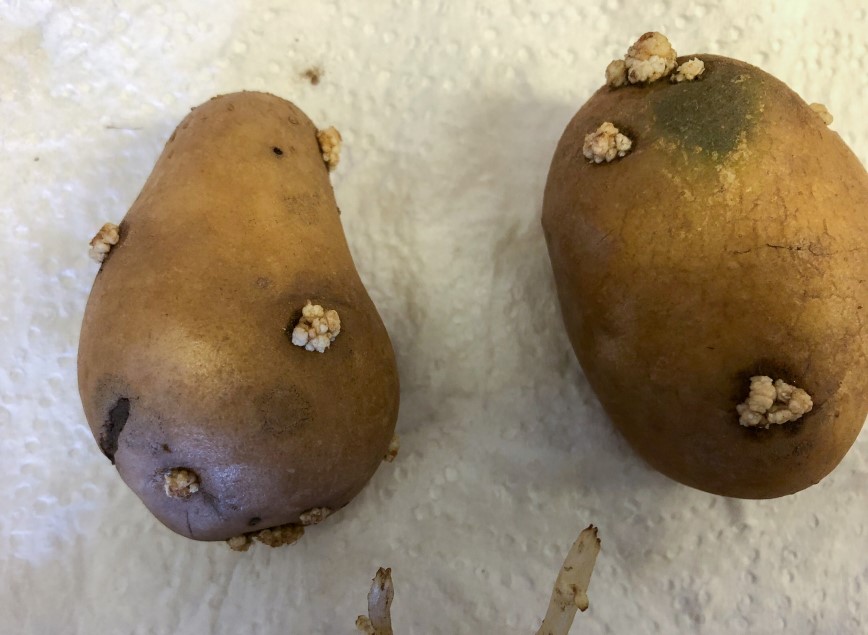
POTATO producers are being urged to talk to any neighbouring cereal growers before harvest herbicide applications.
The advice follows a warning from specialists that avoidable herbicide damage continues to ruin seed potato crops every year.
Just a small amount of herbicide can have severe consequences, with damage often remaining hidden until the harvested tubers are planted the following season.
Darren Wonnacott of Frontier Agriculture says the issue is often caused not by seed growers themselves, but by neighbouring growers as they desiccate cereal crops before harvest.
“The biggest concern is where seed growers rent fields that are surrounded by crops that require a pre-harvest glyphosate application. Seed growers must go and speak to the cereal growers when they’re spraying off their oilseed rape or their spring barley and remind them to be extra cautious about drift and the sensitivity of the crop growing next door,” said Darren.
While it can be assumed that oilseed rape desiccation is complete across England, Darren says Scottish growers should remain particularly vigilant as spring barley burn-down gathers momentum.
“I think that’s where we’re getting the majority of the issues with herbicide damage in potato seed,” he said.
Glyphosate is the biggest concern, although sulfonylureas, aminopyralid and other hormone herbicides can also cause serious problems in potatoes.
This can be through spray drift, contaminated sprayers, contaminated manure or the persistence of some herbicides in soils and crop residues.
Kyran Maloney, senior potato consultant SAC Consulting (part of Scotland’s Rural College), describes potato crops as exceptionally sensitive to herbicide injury.
“We investigate spray drift cases every year. We also see contaminated tanks where the sprayer has not quite been washed out properly. It happens much more often than you’d like. I think people need to be aware, particularly for seed potato crops, of the potential for things to go wrong. It can be extremely costly for all involved.”
One of the biggest challenges is that damage is not always immediately visible.
“If glyphosate drift occurs late into the mother crop, you might not pick it up at all. The tubers might look fine until you try and produce a crop the following year, then it’s often a mess.”
Darren is currently investigating a case in Lincolnshire where the consequences only became apparent after planting. Just 15% of plants emerged from the contaminated seed.
“At the time spring barley is being sprayed off, a potato canopy can already be senescing, so a waft of glyphosate across it might not show any obvious symptoms. But the repercussions into a ware crop can be a complete write-off. You only need a ‘snifter’ to do real damage.”
Both specialists say prevention depends largely on better communication between growers in seed producing areas and good sprayer stewardship.
“Regular conversations are important, particularly where you’ve got something obvious like oilseed rape growing next to seed potatoes.
“Most contractors are really good, but just make sure everybody is very clear where things can go wrong,” says Kyran.
He also advises growers to think carefully about sprayer logistics, particularly in relation to damage from contaminated tanks.
“If you’ve got a lot of crops to spray, think about what the week looks like for the sprayer, when the washouts are taking place and what it’s been in before it goes into potatoes.
“Some seed potato growers even have a separate sprayer for potatoes, just to avoid the potential for grassland products or other herbicides ending up causing injury,” Kyran said.