
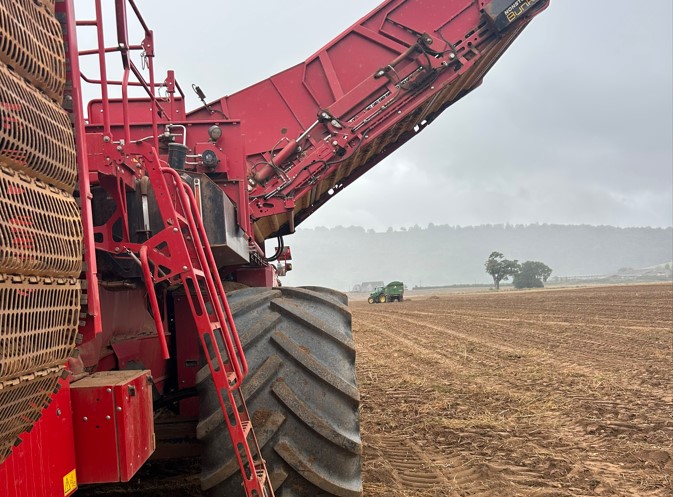
SINCE potatoes are living, breathing organisms, haulm destruction needs to be planned well in advance, as success depends on timing, method and environmental conditions, says Andrew.
Reflecting on the 2025 potato crops, he said many ran out of steam and had an unnatural early senescence as they died dehydrated. As a result, tubers grown on a vast range of soils from sandy to clay, had unusually high dry matter (DM) levels, resulting in potential for increased bruising.
The time between stopping growth and harvesting was often shorter than normal, but both irrigated and non-irrigated crops took longer to achieve skin-set than expected.
“Skin set is crucial as it reduces the risk of losses from bacteria, fungus and viruses entering the crop and also minimises moisture loss,” said Andrew.
Soil temperatures at lifting – which were around 20 deg.C – were also higher than normal, resulting in warm tubers.
“Ideally the tubers should be at a suitable temperature for curing when they go into store, which is between 10-12deg.C, as a result they had to have large volumes of air blown at them to cool and cure them,” Andrew said. “Because the potatoes were going in so warm, this caused premature sprouting, so many growers had to apply a sprout suppressant earlier than normal. In hindsight, perhaps we should we have left them longer in the field for temperatures to drop.”
Storage requirements should be taken into account with all crops needing to go into store in the best possible conditions, he reminded growers.
“Storability is an important varietal trait, but we also need to remember that a tuber will never come out in better condition than it went in. A store is not a hospital and you need to ensure that the necessary four or five weeks have passed so the plant has completely died off and a good skinset complete.”
Andrew adds that many growers would have liked to irrigate before lifting but found that they were unable to keep up with the speed of harvesting and/or did not have labour available.
“We are unable to control the weather, and we may have more seasons like 2025, so although a ship does not sail on yesterday’s wind, we need to learn the lessons from how to get the best crop in dry conditions, just as we do from wet ones.”
He emphasises that plans for haulm destruction should be devised well before planting, and one of the critical areas is nitrogen management, which depends on determinacy, whether the crop will be harvested green-top or is destined for long-term storage.
Many growers have been considering reducing their N applications, so that the crop starts natural senescence and becomes easier to desiccate. However, points out Andrew, if 200 kg/N/ha is applied but other nutritional elements are not in balance, this can affect plant health and growth.
Varietal determinacy also plays a key role because of its influence on haulm size and density. For example, indeterminate varieties not only grow a lot of haulm, but the haulm is also very long lasting. Later maturing indeterminate varieties can be more difficult to flail effectively to an even length, and the length and greenness of stems affect effectiveness of topping.
“If you have a vigorous crop, a pre-flail chemical desiccation is very effective when applied five to seven days before flailing. This helps the crop to switch off in a more gradual way.”
Field layout and soil type also come into play when devising desiccation and lifting strategies, says Andrew.
“When planning, take note of any rented fields which need to be vacated by a certain date and look at the order the fields have been planted in.”
While many potato growers harvest in the same order they plant, others have different approaches, he reveals. “Some of the growers I work with like to ensure they have good harvesting options in both wet and dry harvest conditions, so they divide their fields into ‘dry’ and ‘ wet’ soil categories.
“This means that if the weather is dry, they can make a start on the ‘wet’ soils, and vice versa, thus widening the harvest window.”
There are a number of different haulm destruction approaches, including applying a desiccant spray to the haulm before flailing, or going in straight with a flail and then following with a spray, or two or three applications of desiccants followed by a flail on the front of the harvester.
When flailing is done before desiccating, he advises using air inclusion nozzles, but after flailing, angled nozzles work best to cover all sides of the remaining haulm. This is because the desiccant works on contact to break down cell walls and cause dehydration.
When using a chemical desiccant, warm, dry weather is ideal for it to work quickly.
Andrew recommends doing a number of digs across different areas of the field to get a broad view of crop development and tuber size prior to desiccation. Tubers should be cut open and inspected for signs of vascular browning.
“If you have a seed crop, the kindest thing is to spray the foliage to slow the crop down and make an artificial start to senescence, rather than flailing a green crop that is still growing vigorously.”
The actives used, Spotlight (Carfentrazone-ethyl), Gozai (Pyraflufen-ethyl) or Albis (Pyraflufen-ethyl), are broadly similar, and Andrew recommends sequencing rather than mixing them.
“The key is getting the application right. For example, if the desiccation plan is to first apply a chemical desiccant, water rates need to be at least 300l, said Andrew. “Any less than that, the efficacy drops off, and if in doubt, it is better to go above this.”
Weather also affects efficacy, and haulm destruction is best done on a sunny day, desiccants are best applied between mid-morning and late afternoon.
As the plant dies off, late blight remains a threat, he says and he recommends a tank mix of Ranman (Cyazofamid), Gozai and oil, adding that Infinito (fluopicolide) can also be used at harvest. However, he cautions that other blight sprays offering tuber blight control do not have approved tank mixes.
Water volume, forward speed, machinery set-up and choosing the correct nozzle are key to effective desiccation, said Andrew.
“The flail should be set to cut between 15 and 20cm above the ridge top, and blades need to be sharp. It’s very important to go sufficiently slowly to give the flail time to work, and when done correctly, the haulm should go to the bottom of the furrow.”
While trials have shown it is possible to desiccate using just chemistry, most growers choose to flail as well, and choice depends on weather conditions.
“If black-leg or late blight are present, spray before flailing, as flailing can spread pathogens around,” he said. “Trial work has shown that if you spray before flailing, stolon detachment is better because it is a more natural process, but it comes at a input higher cost.”
Spotlight should be applied at 1l/ha followed by 0.6l/ha, while the spray rate for Gozai or Albis is 0.8l/ha for pre- or post-flailed crops.
The crop should be checked for regrowth at the base of the stem, he notes, explaining that if forward speed had been too high, or less than optimal water volumes had been used, insufficient desiccant may have landed on the haulm, so the crop may need another application.
“Sometimes two stem desiccations may be necessary, but before doing so, you need to check your maximum applications for the product you use. For example if you applied Gozai at 0.4l/ha as a herbicide, because it has a maximum per season of 1.6l/ha, you will have to look at another active such as Spotlight for the second desiccation spray.”
He reminds growers that if they change desiccant, they need to keep in mind that Spotlight has a seven-day harvest interval, while for Gozai it is 14 days.
“Once you have finished flailing, you should leave the crop between 24 and 48 hours before going in with a stem desiccant to give time for the haulm at the top of the ridge time to dry off.”
Bruising occurs when a mechanical impact damages the tuber’s cells, resulting in black pigments, and therefore affect eating quality. Careful harvest and grading operations, alongside frequent monitoring damage levels, could help potato growers save themselves thousands of pounds a year by reducing the amount of tuber bruising that occurs during and after harvest, Andrew said.
“We need to make more use of hotboxes, because monitoring samples helps growers keep a close eye on bruising,” he said. “In the light of what we saw last year, we need to know more about where damage risks occur.”
Regular samples taken at every stage and hot boxed will help pinpoint where any problems are, so action can be taken, he advises.
“We find taking five or six samples each of 25-30 tubers from each harvester at different times of the day is useful.”
Tuber susceptibility to bruising mainly depends on varietal tolerance and the growing environment. Nonetheless, despite the dry weather last year and high dry matter levels, some susceptible crops were loaded into store without problems.
This highlights that care taken at harvesting and grading can make a real difference to outcomes.
“Good training of harvesting and grading teams will make them aware of the importance of the work they do.”
Small changes in turgor and tissue elasticity in the tuber influence bruising susceptibility, and potential damage depends on a fine line of balance between too much and too little water, notes Andrew.
Soil moisture levels in the field at harvesting can make a big difference to tuber damage, and the ideal soil moisture deficit (SMD) is around 50mm. However, this is difficult to control; if conditions remain dry, irrigation can help by increasing turgidity and help cushion potatoes as they go up the first stage of the harvester.
“If soils are dry (as they were last year), crops irrigated before lifting tended to suffer less mechanical damage and subsequent bruising.”
Soil temperatures at lifting can also affect the risk of bruising; when above 10 deg.C the likelihood of damage is much higher than at 8 deg.C, so earlier harvesting can be quite different to when it is done in October.
Attention to detail on machinery set-up is ever more crucial, says Andrew, pointing out that checks should be done on pinch points for potential bruising.
Some people find mats or cushions to be useful, too, he adds, observing that new air harvesters, which have an air stream to blow out debris, are now being used in the US and New Zealand.
“Bruising management is crucial because it is affected by many factors and impacts greatly on the grower’s bottom line.”
While fertility building cover crops can be helpful in the battle to keep inputs to a minimum without compromising quality or yield, they still have costs associated with growing them, says Andrew.
These are typically £40-50/ha for the seed, with another £60/ha for cultivation and labour, and should provide around 20t/ha of biomass above ground with a healthy root biomass as well.
“Many growers plant stubble turnips before a spring crop as they then receive a visible financial benefit, which they do not perceive to get from a cover crop.”
However, when stubble turnips are grazed off, the sheep can leave wet, muddy, poached soils, often with wheel ruts and tracks, which need rectifying. He recommends controlling sheep numbers, and advises that care should be taken to not graze the cover crop down to the earth but leave 5-7cm of above ground biomass.
“A cover crop which can be destroyed and incorporated can be useful, particularly if it is a mix of cover crop and stubble turnips.”
On heavier ground, destruction may need to be done earlier than on light soils as they take longer to dry out.
“Cover crops are an integral part of good soil management, and the aim should be no bare stubble fields over winter,” says Andrew.
“Growing a cover crop reduces the impact of the rain on the bare soil. The weight of winter rainfall is often referred to as having the same weight as eight bags of potatoes on top of each other, pushing the soil down. Having the ground covered helps reduce the impact of this weight.
“In addition, by having roots in the soil, cover crops help to reduce soil erosion and the consequent loss of nutrients such as phosphates.”
Other benefits include reducing run-off and leaching of all-important nutrients.
“Moreover, cover crops help improve soil structure and therefore increase organic matter content and water holding capacity.”
Decisions on which mix to buy will depend on the needs of the particular field and soil conditions and how it will be destroyed afterwards.
“This will depend on your system and rotation; some growers flail and chop it, others disc it; and best practice suggests it should be incorporated into the soil before final cultivations.”
Addressing concerns about winter cover crops providing a green bridge increasing predator numbers in spring crops, Andrew notes that benefits from cover crops outweigh the threats. However, it may result in higher numbers of slugs and/or wireworm, which may need managing.
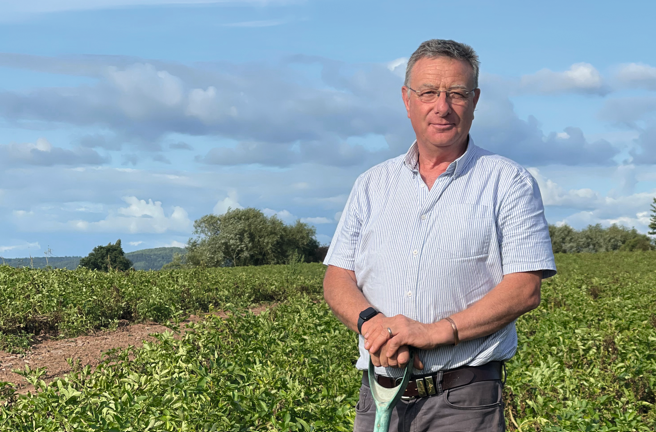
Andrew writes a regular column looking at seasonal strategies for British Potato Review. An Agronomist and Potato Specialist based in Herefordshire, he looks after nearly 8,000 ha of potato fields in the Welsh borders, south Shropshire and Worcester, most of which are destined for the crisping or processing markets. Andrew Goodinson has been working for Hutchinsons for 17 years.