
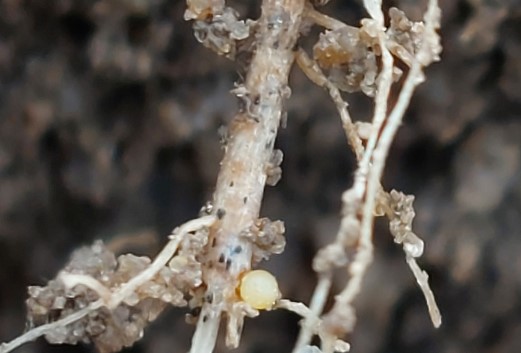
PCN remains one of the most persistent challenges facing UK potato production. Managing it always requires a joined-up approach, combining accurate soil testing, variety choice, rotation, crop management and, where justified, the responsible use of granular nematicides as part of an integrated pest management strategy (IPM).
Before any of those decisions can be made, growers need to know what is in their soil.
Simon Alexander, independent agronomist and Nematicide Stewardship Programme group member explained why.
“Soil testing gives you the information needed to make informed decisions, but it is important not to interpret figures too literally,” he said.
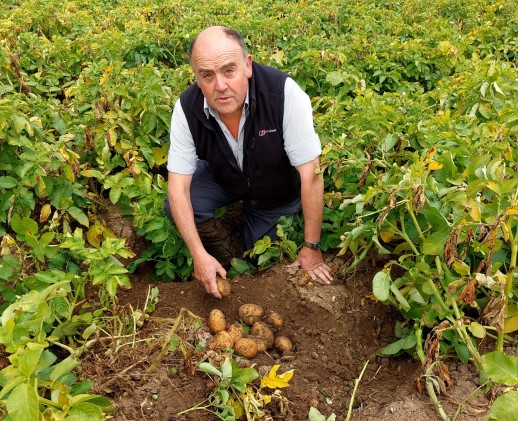
Soil sample results will usually indicate PCN cyst numbers per 100g of soil and egg numbers per gram of soil.
“The egg count is the figure that tells you the current burden, while the cyst is the protective casing that contains the eggs, and because cysts can survive in the soil for a long time, they show historical PCN activity,” said Simon.
Misinterpretation can also occur, particularly when results vary across a field or return as ‘none found’ in some sampled areas. Simon stresses that none found does not mean none present.
“Remember the soil sample result is based on a very small amount of soil compared with the size of a hectare,” he said.
“A 200g sample per hectare is only a handful of soil, so the chance of missing eggs or a PCN hotspot in the sampling is significant.”
As well as understanding pressure, growers should pay close attention to the species identified in the analysis.
Knowing whether Globodera pallida or Globodera rostochiensis is present will influence the most appropriate next steps, particularly when choosing resistant and tolerant varieties.
“PCN species identification is becoming an increasingly important management tool,” Simon said.
“Knowing what you are dealing with helps growers build the right IPM plan and get the best out of resistant varieties.”
This is especially important where growers are relying on variety choice as part of a long-term PCN strategy. Resistance can help reduce multiplication, while tolerance helps protect yield under pressure, so understanding both the field result and the variety profile is essential.
Soil sampling gives growers the best available picture of PCN pressure, but at very low levels, PCN can still be missed.
The more soil sampled, the more reliable the result is likely to be. However, this has to be balanced against the cost and practicality of sampling.
Simon says growers looking to improve monitoring accuracy should consider reducing the size of the sampled area, increasing the number of samples taken and increasing the overall sample size.
“It is important to know where your hotspots are,” he says. “The more detailed your sampling, the better your understanding of how PCN is distributed across the field.”
He also advises growers to think carefully about timing.
“Sampling two years ahead rather than just before the potatoes are planted can be advantageous because it gives a more up-to-date picture of the field and allows you to be more proactive,” he says.
“This way you have time to make better decisions, but it is still close enough to planting to give a more useful picture of current pressure.”
Once soil sample results have been interpreted, and species identified, the next step is to decide on the most appropriate IPM strategy and where to use products containing fosthiazate, such as Syngenta’s Nemathorin, which is an established option where nematicide use is justified within an IPM plan.
Sampling early enough gives growers more opportunity to consider cultural control options, including trap cropping and biofumigation, both of which can play a role in control, but differ in how easily they fit into commercial rotations.
Trap crops often require a full growing season, typically from June to October. Whereas, biofumigant crops can be drilled in late July or early August and incorporated before October.
Where growers want to use these tools, decisions need to be made early enough to secure seed, plan field operations, irrigation if necessary and fit the crop into the rotation.
For fields with very low PCN pressure, decisions may be more nuanced. Simon says granular nematicides may not always be required where pressure is low and a necessary and resistant variety is being grown, but this will depend on a range of factors.
“When deciding what to do next, growers need to consider soil type, the variety, their experience of growing that variety and the field history,” he says.
“Soil type makes a big difference to PCN levels per unit area, so decisions need to vary depending on bulk density. For example, a count of five eggs/g in an organic soil may equate to around 20 eggs/g in a mineral soil.
“Also, if you are trying a new variety, make sure you interrogate the breeder or their agent for any information as to how it will respond to different levels of pressure. Many of the processors and packers will have information from their own trials as well.”
Where pressure is very high, the decision may be more fundamental, he adds.
“If PCN levels are very high, it is worth asking whether potatoes should be grown in that area at all.”
If soil sampling leads to a control strategy which includes granular nematicides, growers should seek advice from a BASIS-qualified agronomist first.
Simon says the aim should be to make decisions based on evidence, rather than habit.
“Understanding your PCN pressure has never been more important,” he says.
“The growers in the strongest position will be those who know the challenge they are dealing with and know how to use the range of management options available.”
That means using soil sampling as the starting point, interpreting the results with care, identifying the species present and planning early enough to use the most appropriate combination of tools.
For growers looking to protect land for future potato crops, PCN control is not simply a planting-season decision. It starts with knowing what is in the soil today and using that information to build a more resilient plan for the years ahead.
NSP group member and crop production specialist Reuben Morris, explained how Frontier Agriculture ensures optimal accuracy in soil sampling.
“PCN is difficult to detect due to its uneven and unpredictable distribution across fields. Often introduced at a single point, it can be spread by machinery, creating random hotspots that make traditional sampling methods unreliable. To address this challenge, we at Frontier Agriculture use a systematic and precise approach. Our soil sampling service divides each field into 1-ha blocks, ensuring full coverage rather than relying on limited sampling patterns.
“Within each hectare, we take 50 soil cores to a depth of 25 cm, which are then combined into one representative sample where a minimum 200gm is per sample is inspected. This method significantly increases the likelihood of detecting PCN wherever it may be present.
“By using this grid-based sampling strategy, we provide growers with a more accurate picture of infestation levels across their land. This enables better-informed decisions on crop planning, management, and treatment, ultimately helping to protect yields and reduce long-term risk.”
Before planting begins, growers are encouraged to visit the NSP website to update their knowledge on best practices for application of granular nematicide for the control of PCN.