
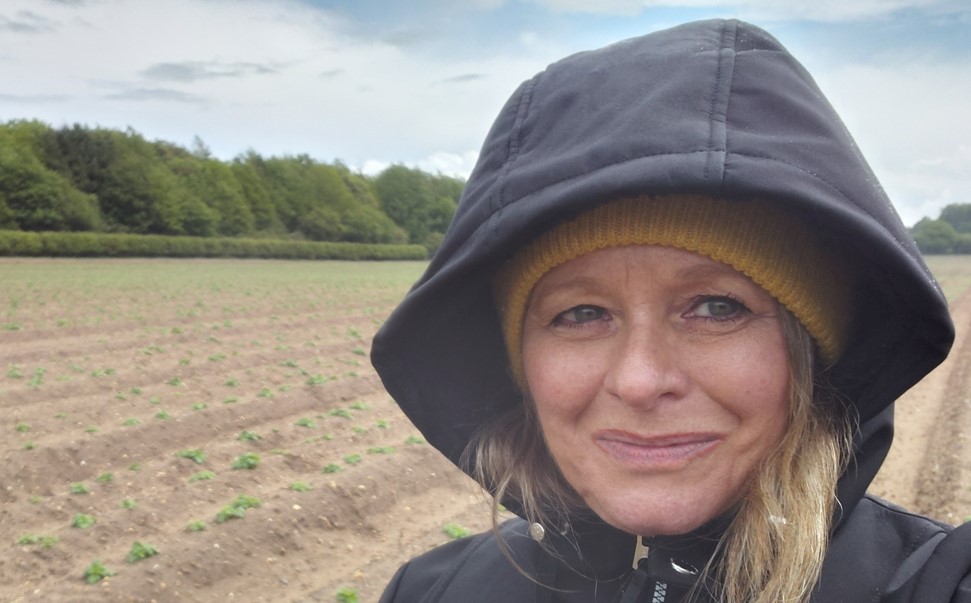
A ‘CROP Doctor’ field briefing for potatoes recently featured an informal in-field discussion around potato blight, including disease prospects for the 2026 season, blight programmes, resistance management, and stewardship.
Independent experts, distributor agronomists and members of the Bayer CropScience UK technical team met in fields in Norfolk and Suffolk, with some interesting discussions taking place following the first UK identification, late last year, of the EU43 blight strain.
The Crop Doctor is a field-day series from Bayer CropScience UK that provides agronomic advice and disease management strategies for British potato growers.
In regions like Suffolk, where warm, humid weather creates ideal environments for potato late blight and the program focuses heavily on anti-resistance management and applying systemic and fungicides that are applied to the top of the leaves, the topic is never far from agronomists’ minds.
The ‘doctors’ recently embarked on their late spring field tours, focusing heavily on fungicide decisions and crop protection for potatoes. The field doctor team highlighted the need for broad-spectrum disease control to protect yield potential.
Out in Norfolk, at Banningham near Aylsham, Frontier agronomist Emily Harrod and Agrii agronomist Ed Maule, surveyed the potato crops growing there and offered their feedback, while in Pickenham, near Swaffham, VCS agronomist Graham Tomalin joined the Bayer technical team and media members including British Potato Review’s Stephanie Cornwall to look and giving his diagnosis.
During the Aylsham visit, the agronomists said this was the first season where the growing industry would be able to see what repercussions there would be from the withdrawal of mancozeb and how this would impact on blight control as the season progressed.
Graham held a similar view, when he spoke at the Pickenham site.
“We’ll pick up on varieties and what sort of tolerance they really have,” he said. “With most, it has been shrouded pretty well by mancozeb at seven days on a lot of crops.”
Graham specialises in potato agronomy, predominantly in East Anglia, but works further afield when he is needed.
The Maris Piper crop growing in the Pickenham field was destined for pre-pack, to be sold by a whole range of supermarkets in the UK and had been planted four weeks prior to the visit. Graham said the soil it was growing in was “pretty light sand”.
Considering the recent frost, the crop, which had been planted four weeks prior, was developing well, he said, adding that the biggest challenge was trying to wet the soil up for the scab control and growth development stage. The crop was not quite at tuber initiation stage and conditions in the area had been predominantly dry and warn, despite heavy rain that day.
When asked how he would approach this sort of light risk scab scenario, Graham said he’d began a program began around the end of April, using cheaper chemistry for the very first spray, then bringing in chemical or biological crop protection agents (systemics) as the canopy was extending quickly. Anti-resistance would also need to form part of the strategy, he said.
Asked what intervals he’d be looking at starting with for blight control treatments, he said: “On this farm, initially it might be slightly wider intervals because it’s been low risk, so probably eight to nine days. At different times, we’d use a different process, for example we might stop irrigation and spray the crop on the same day.
With the withdrawal of mancozeb, historically relied upon to control Alternaria (early blight), made things ‘interesting’ he said.
“There is no doubt the risk of Alternaria will increase. Previously, mancozeb was always just in the background so there is always the potential for Alternaria to develop without it. It’ll be interesting to see where we get the disease and how it progresses.
“Alternaria is quite an interesting subject in terms of the different types. There is disagreement between various people regarding the significance, or not, of Alternata compared to Solani. I’m in the camp that thinks that Solani is the main threat.
“Alternata is a live-on sort of affected bore dying tissue, but and it’s in the atmosphere everywhere, and it’s much less significant in my opinion than Solani, which actually can take green foliage out quite quickly.”
The EU 43 blight strain had recently put in an appearance nearby at Framingham – a factor that was affecting the blight control approach this season.
“I think the key to our blight program will be to make sure we’re covering different chemical groups, really. We’ve just got to make sure we cover them for anti-resistance,” said Graham.
“We’ve got away from all this “There’s a resistance to this – don’t use it” which happened first with Metalaxyl and then Fluazinam. We can’t do that anymore. We’ve got to use the chemistry that’s there, but use it with the right partners so we’ve got an anti-resistant strategy over the whole program, and make sure we’re not going with the same chemistry again and again, but mixing the chemistry both within an application and over the program.”
Asked whether he thought there was enough chemistry out there currently to help growers stay on top of things, Graham said: “To be within the guidelines that we’ve got, I think it would be challenging if we had an outbreak. Up to having outbreaks in crops, it will be fine. However, if you get an outbreak and you’ve got to try and cure that outbreak, then we will find it more difficult and will quite quickly run out of options.”
The season had included some varied strange weather conditions, with fluctuations in temperature, being very dry in places, but Graham was keen to share that the outlook was good.
“I think there’s a lot of promise in the crops. They were ahead. I think there are still some crops that are ahead – but there’s not many of them. There are a lot of crops that have not grown much over 10 days since it went colder, so there’s that variation, but the potential is still there,” he said
“Soil conditions were very good at planting, bar the very first 10 days in my area that were a bit tricky. Beyond that, conditions got better and better, and if plants are able to root well, then they normally perform, as long as they get enough water. That is going to be a challenge, whether that’s enough water in rainfall or enough water in irrigation, carrying on all season.”
Planted acreage had decreased this year, he said.
“It’s a bit varied between growers, but overall it’s gone down a little bit. I would say probably 5% as an average. They’re leaving out fields that are a bit more difficult, and corners of fields where they’re straightening them up for irrigation. It’s bits and pieces rather than whole-scale changes at the moment.”
Current weather conditions also meant the prospects of scab development were high, he said. The bacteria thrives in dry, light soils with a pH above 5.5 and primarily attacks young, expanding tubers three to six weeks after tuber initiation.
“The growers that know scab control, and can irrigate frequently – that’s more than once a week because once a week just isn’t enough no matter what weather we get – are in a reasonable place, and they’ll do what they do most years.
“They’ll be fine, provided it doesn’t take too much water resource from later in the season – that’s the real challenge.”
Tom Astill, a Technical Specialist at Bayer Crop Science, said his team is continuing to monitor resistance to blight strains and spoke about how to get the best out of the product portfolio.
“Be prepared to start protection as early as possible. You can’t chase your tail with disease – it’s all down to preventative applications with appropriate intervals – ideally seven days or less,” said Tom.
“Be aware of what genotypes are in the area and which pose a risk. Use the Fight Against Blight program to track outbreaks, and report any outbreaks, and really ensure you properly plan your control program, using current guidelines which do account for some of the new genotypes in the UK.”
To stop resistant late blight strains from taking over and destroying the crop, Tom advises holding back some modes of action for critical periods in the growing season.
Bayer’s portfolio for blight control includes Infinito which has been around for 20 years. Talking about how the product works, Tom was keen to advocate how the its two active substances, Propamocarb hydrochloride and Fluopicolide, complement each other.
“They have different modes of action, targeting different modes of action within the cell, so we’re keeping on top of everything with the Propamocarb, while the Fluopicolide is very systemic,” he said.
Propamocarb is absorbed into the plant’s tissues and moves upward, protecting new growth and unsprayed areas, while Fluopicolide disrupts the pathogen’s cell structure and cytoskeleton stability, stopping the disease at multiple stages of its life cycle, he said.
“Because they attack the pathogen through two entirely different biochemical mechanisms, the combination helps prevent the blight pathogen from developing chemical resistance,” he said.
“With our sensitivity monitoring, we’ve not seen any shifts to Propamocarb or Fluopicolide sensitivity, so Infinito is particularly strong, and it can be used throughout the programme. As I said, it’s quite systemic, so quite useful in those periods of rapid growth, but also when there’s high risk of zoo spore infections, when it gets wetter and cooler later in the season.”
The minimum time between the last application and harvest is seven days, so it can effectively be used up to harvest, said Tom.
Caligula, launched around five years ago, is specifically geared towards controlling early blight and Alternaria, Tom stressed, and doesn’t have any late blight activity.
“It’s a co-formulation of the prothioconazole and fluopyram, so you’ve again got two different modes of action. You’ve got a DMI (Demethylation Inhibitor) and an SDHI ((Succinate Dehydrogenase Inhibitor),” he said, adding that this made it effective in terms of activity and resistance management.
Crops had been later emerging than last season, he said, with the exception of some early crops.
“It’s been a dry season so far but things can change very quickly. Obviously, a lot of diseases are fairly insidious. They sort of sit there, and then you only need the right weather conditions for them to proliferate.
“This season, we’ve also got, potentially, new genotypes which we could be seeing have knock-on effects on CAA (Carboxylic Acid Amide fungicide) activity in fields, if the programmes aren’t strong enough. Obviously, we haven’t got the background use of mancozeb this season as well so this a new thing we’ve got to take into account this year.”
His team is continuing to monitor resistance to actives, he said.