
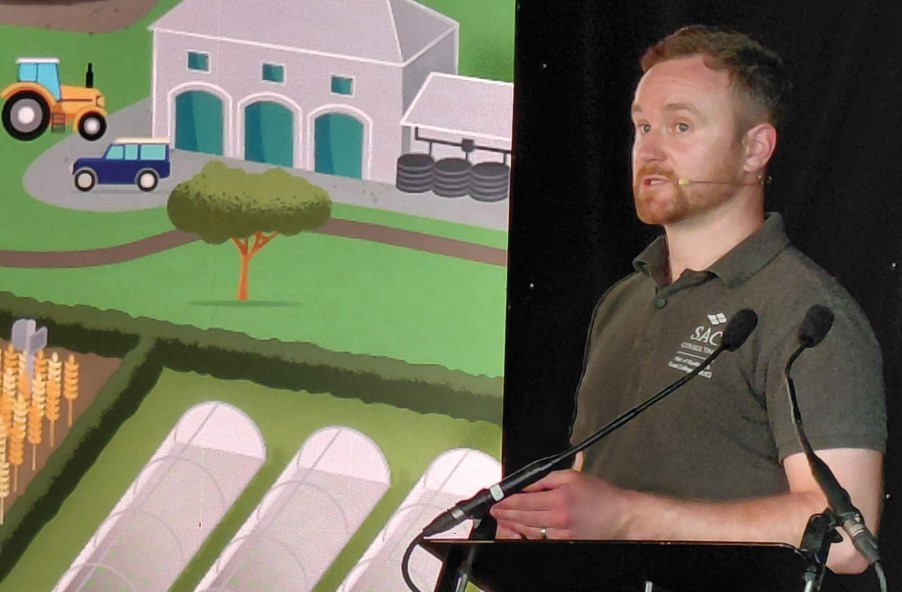
FINDINGS from the Centre of Expertise for Waters (CREW) water project and what this means for the British potato industry were recently put into the spotlight by Senior Potato Consultant within SAC Consulting, Gavin Prentice.
Speaking at a Potatoes In Practice seminar, Gavin pointed out that the climate and water availability are changing in Scotland therefore preparations need to be made to counter this.
“Traditionally, we’ve thought of ourselves as a particularly wet country, or damp perhaps, but that is certainly changing, so we have to make sure that we are looking at things ahead of time to make sure that we are resilient and prepared,” said Gavin.
His presentation focused on managing water scarcity, using research from the project, to provide an overview of water resilience and irrigation best practice specifically tailored for potato production in Scotland. Alongside this, he highlighted a video series created for Scotland’s Farm Advisory Service to help farmers assess their hazard, exposure, and vulnerability to water
The reasons behind the document’s creation were evident at the time of the seminar.
“We are facing droughts and our weather patterns are changing a lot,” said Gavin. “We’re seeing some really extreme weather, and facing drought and waterlogging conditions.
The document was commissioned by CREW at the behest of the Scottish Government and SEPA, the Scottish Environmental Protection Agency.
“Stress in potatoes causes a whole heap of problems. If you look at the scientific literature, this gives you a bit of an indication as to where we are in terms of what the reducing effects can be in periods of high temperatures and reduced rainfall so crown cover, canopy cover reduces. There’s a little bit of debate over tuber numbers, root length, root mass, but realistically it’s all a reduction.
“Maybe you might have benefited as a seed grower but certainly not as a ware grower. Ultimately, we get to the point where it’s so dry that we can get crop canopy death for sustained periods which we do not want so in order to avoid that, what can we do?”
Risk assessment should be the first point of action, he stressed. “The three ways that you could potentially look at this are to first try to identify your hazard ie the likelihood of water scarcity happening in that area either because of reduced river flow rates or prolonged drought.
“Then consider your exposure. Do you know how much your crop requires and at what times is there going to be enough? Think about your vulnerability – if the tap goes off, what is your risk and what is likely to happen? As a wise man once said to me, if you can’t measure it, you can’t manage it.”
Building a baseline was the first step towards creating a hazard map, Gavin said.
Knowing when a soil’s water-holding capacity is low was the first step, he said, advising growers to look at the SEPA website for details on water scarcity indications. While it does not track climate-related water scarcity data or drought indexes directly, it addresses water resource pressures and scarcity through smart farming technologies, precision irrigation, and crop protection tools.
Gavin demonstrated a colour-coded map, showing where there was moderate water scarcity and abstraction reductions on licenses at the end of July.
“If you build a baseline, you’ll know when the area, farm, location and field is going into water scarcity. You can build that picture up over time so you can map the time and the frequency that it’s in scarcity, based on the map, based on in-field weather station data, and based on rainfall from the Met Office or your own weather stations too. Monthly and weekly, you can build that up.”
The second consideration should be exposure, he went on to state, advising the creation of water source maps and demonstrating one featuring a farm with an irrigation pond and river courses where the grower might have a license to extract from. While the map showed that particular grower was in a good position, clearly revealing what the requirements were for his crops and how much would be required to sustain this, the challenge would be matching that in peak demand during a dry season, Gavin said.
“The last scenario to look at is your vulnerability and whether you have a plan for drought. Do you understand the soils? Do you know how much water they can hold? Obviously farms that are irrigating from smaller water courses don’t bounce back as quickly, so if you know that you’ve only got that one source available to you, it may be that you’re going to be more exposed in these scenarios when the water dries up or is less available.”
Evaluating available backup at this stage was crucial, he said. “A hazard could be: How likely are your low flows to affect your business? Exposure – do you know how much water your farm needs? Vulnerability – do you have water supply if obstruction is reduced?”
Having assessed and documented the hazard, exposure and vulnerability, growers can use the CREW document to assign points or score their vulnerability or risk, before considering the suggested next steps.
“I appreciate on a season like last year where prices were low and demand was low, going into a bit of a mixed season again, investment isn’t always the easiest option for people to take but there are strategies and different things you can look at for building resilience. For example, if you’re looking at your water availability or your efficiency, and you have soil moisture-monitoring in your field, you can be a lot more efficient in your application of water, safeguarding the resource. You can get onto the crop when you need it and think about infrastructure such as irrigation lagoons, looking for boreholes etc.”
The are also many ways to adapt or change irrigation methods, he said.
“We’re very heavily reliant on rain guns in Scotland, purely because irrigation isn’t always the first port of call – we can get away with rain-fed crops quite a lot and we might only need a few pools of the irrigator in some seasons,” he said, although he acknowledged that this practice was slowly changing.
He advised that long-term strategies involved looking at improving soil health and organic matter so that water was retained in the soil profile for times when it was really needed, and looking to minimise or safeguard water supplies by reviewing crop and variety choices.
“We have a lot of varieties out there and some are better at drought resistance than others so you can factor that into your thinking.”
In Scotland, growers had historically been “quite liberal” in their water use because there had been a plentiful supply, but that pattern had been changing over the past 10 years, Gavin pointed out.
“We have to heed the warnings of our friends on the continent and those down south because it’s better to be resilient now and build for the future.”