
MILDER winters have caused aphids, the primary vector for the Potato Leafroll Virus (PLRV), to fly up to three weeks earlier than average, elevating virus risks. Over the past eight years, this has led to recorded incidents in the UK increasingly dramatically.
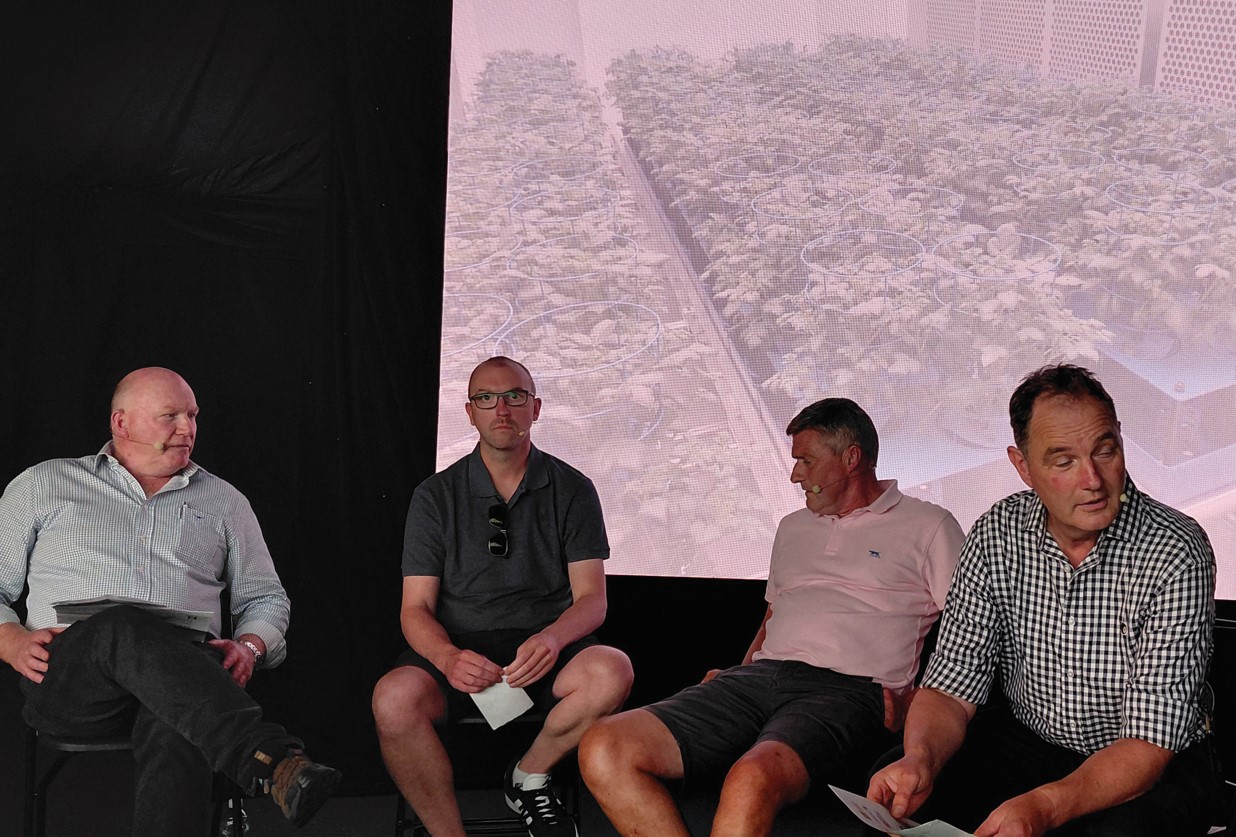
Chairman of the Potato Sub-Committee for the Scottish Society for Crop Research (SSCR), Andy Steven, chaired a Potatoes In Practice seminar session whose panellists included Alistair Melrose, Commercial Director of Perth-based J&E seed potato grower Smillie Potatoes and and past president of BPTA; Ryan Torrie, General Manager at Aberdeenshire seed growing company J.S. Cruickshank and Vice Chairman of PB Growers Association; and Jamie Harrison, Director of Norfolk family growing company E G Harrison & Co and HDF Farming Ltd.
Andy urged people to sign up to the ‘Six Steps of Virus Control’, an integrated management strategy developed by the Scottish Aphid-borne Virus Working Group and promoted by GB Potatoes that is used in UK potato growing to prevent crop degradation from aphid-vectored viruses like Potato Virus Y (PVY) and Potato Leaf Roll Virus (PLRV).
Its aim is to get growers and people involved throughout the chain in a discussion about the virus and the challenges the industry is now facing, he explained.
“The targets are changing,” Andy said, stressing that mosaic, a specific class of foliar symptoms caused by viral infections, is back and there is PVY in crops.
“It’s not just one virus we’ve got to deal with. It applies to them all,” he said.
The panellists discussed some of the effects being felt within production and procurement this year.
Ryan works on around 350 acres in Aberdeenshire where around 35 different varieties are grown for various different companies. He said the landscape was very different to 10 years ago and that leafroll has presented the biggest challenge for him since 2018.
“Levels have been ramping up. We hadn’t had a leafroll problem really for probably the previous 10 years but it has been very much going up over the last few years. We generally don’t see it at our stage at relatively high levels, but, obviously, it’s still managing to find its way into the production system there and if we can’t keep it clean, then what chance does everyone have?”
Alastair grows 700 acres of mainly seed potatoes on rented land, which makes its more difficult to monitor. He said that while the virus level is low, it is “always there”.
He said the virus situation is making things more difficult from both a growing and buying perspective.
“Since 2018 we’ve been growing our own seed, basically that essentially we use ourselves. We take in mini tubers and we bring them forward, we don’t certify anything,” he said, adding that the seed was S grade, having a low tolerance for diseases, viruses, and blackleg, therefore virus was becoming more and more of a problem.
“Fortunately, our high grade supplier in the Black Isle, who grows King Edward, Maris Piper and Estebana potatoes for us, doesn’t seem to have the same issues and, in fairness to him, that stuff has always been good, so we don’t we don’t see major issues there. But we do see it in our own stuff, which we’ve been growing at fairly low altitude for the past three years now.”
Seed growing has now moved uphill to land which could only otherwise be used for grazing so the current field is now 750 feet above sea level, with nothing around it, he said. Natural grass barriers have formed between plots which, while unintentional, are very welcome.
“But still, even at that level, we are finding aphids in the yellow water traps this year. The aphid pressure is very, very low but it has still had an impact on us,” he said, adding that virus risk was always there.
“I think by us keeping generations short, hopefully we’re eliminating the risk of multiplication taking place.”
For Jamie, in North Norfolk where the family business is growing on 400 hectares for Lamb Weston and seed production, buying good quality seed was, as ever, the key to this year’s challenges, as well as the use of aphid monitoring traps.
The family business covers 1,300 hectares where potatoes and sugar beet are grown. Ware production takes place on 400 hectares for Lamb Weston and Albert Bartlett and some prepacked customers and there is 16 hectares attributed to seed production, which goes back into its own business, being supplied to seed houses and Lamb Weston.
“The key for us is buying good quality input stock for one year modification and then sending on,” he said. “Norfolk is heavily concentrated in ware potatoes so finding isolation for seed production is challenging and there are rotational challenges as well. We want to be working on one in eight minimum in our own seed production crops. By using aphid monitoring, traps, regular spraying, we’re keeping leafroll at bay. But with climate change, hotter summers and milder winters, this aphid problem is not going to go away – that’s for sure.
“It’s affecting us all.”
Leafroll had been a serious problem for Ryan last year. While some of this had carried over into 2026, this season the virus situation had been “better than expected”.
“We are we’re still not seeing that much mosaic PVY. It is still mainly leafroll. I suppose the positive to take out this year is that we didn’t see the kind of spike in aphid levels in June that we have seen in previous seasons.”
While aphid levels had picked up slightly at the start of August, things were improving, he said, and he was optimistic that the mature plants were less at risk than when they had been at the emergence stage in June.
Alastair said that while they were being vigilant in Perthshire and Angus, he echoed what Ryan said.
“All our PB2s have passed this year, which is not normally the case. We usually have a casualty within there. Leafroll is the major issue that we find in the pre basic stocks. But it’s been much easier to control, and that surprised me on the back of last year. Certainly, the lower aphid numbers will help us going forward as well, I would hope.”
Jamie said this season’s traps had yielded some interesting results.
“Our low is a 107 index while our high end field is a 160. We’ve also been looking at isolation beds. Last year, we did some trial work with a pot of nectar mix in our isolation beds versus bare land. We’ve done the same exercise this year.
“We hand sewed last year and this year we’ve made up an on-farm small single-bed drill to drill the cover crop mixture in. Unfortunately, because it’s that dry, we didn’t establish any of that mix. But interestingly, in the index, you’re looking from bare land at an index score of 573 cumulative for the season, versus the cover crop 273, versus the crop in field 160. So the range of difference is evident across the field and just the bare land.”
This brought into question the need for having isolation beds on bare land, he said – something others in the industry have also questioned.
Ryan said various methods of mitigation had been tried this year.
“This year, I think we were more successful than we have been previously in establishing a kind of companion crop on our highest grade to try and cut out how much bare land there is within those crops. We were reasonably successful in establishing a barley crop but unfortunately the herbicide mix didn’t knock it back as much as I was expecting.
“There was still a bit of cover there just on emergence which was the kind of vulnerable stage when I was trying to protect it. I still think, looking down on that field, it would be quite a confusing picture for an aphid. As with the straw mulches and other methods we’ve tried in the past, it’s just something to try and creates a more even colour.”
Alastair said he too had previously tried using straw but described the effects as “a bit erratic”.
“It was very difficult to get the straw in the right place and then, if there was a wind like we’ve had this year, and we move it very very quickly, it didn’t serve much of a purpose. I think what we have seen this year is by accident more than good practice.”
Alistair said there had been “a perfect storm” over the past few years in terms of climate, deregulation of pesticides, and market demand, and industry needed to work together over the next couple of years to stay on top of the issue.
“I think there’s a lot of evidence to say that potentially the leafroll problem that we’re seeing in Aberdeenshire, certainly compared to other parts, could be down to the amount of certain varieties being grown – because they’ve been in demand for a certain market and perhaps not been grown at appropriate field generation as well. While we can’t downplay our own responsibilities, I think the whole industry has a a responsibility to try and improve the situation for everyone, and that also includes the certification scheme.”
Groundkeepers, i.e. unwanted volunteer potato plants that grow from tubers left in the soil during a previous harvest, provide a safe home for pests and diseases, and Agronomist Eric Anderson was keen to learn more about the level of “potentially lethal” viruses accumulating in these across the rotational landscape, particularly with rented land.
The Scottish government could learn from the Netherlands in terms of the importance of bare areas in mitigation, he added.
“We’ve got different pressure than we had historically. We need to move with the times,” he said, adding that the pressure was on for roguers removing groundkeepers within seed crops. “If they are accumulating virus when they emerge, then the vectors only need to move it to the next plant to have transmitted leafroll so that’s another context that I think we should bear in mind – how frequently we are removing groundkeepers in seed crops.”