
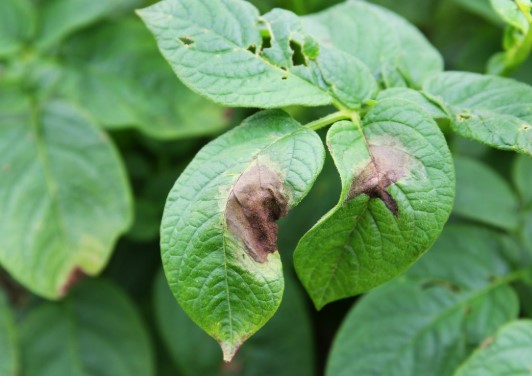
RESEARCHERS from The James Hutton Institute and the Science and Advice for Scottish Agriculture (SASA), have discovered that a new variant of potato leafroll virus (PLRV) is rapidly replacing the historic strain that has circulated in Scotland since at least 1989.
Over the past five years, PLRV incidence has risen sharply in Scottish seed potatoes. Since 2018, the number of seed potato fields reporting PLRV infection has increased nearly tenfold, reaching record levels in 2024.
This year alone, 17.5% of Scottish seed potato crops were downgraded or failed due to PLRV infection. With 78% of the UK’s potato crop originating from Scottish seed tubers, the spread of this virus poses a significant threat to production and supply chains.
A team led by the Hutton’s Dr Eugene Ryabov carried out a large-scale genetic analysis of PLRV samples collected from across Scotland in 2023 – 2024 to determine whether this increase could be linked to the spread of a novel variant and found that an emerging PLRV variant had become prevalent.
Eugene said: “Results of our recent PLRV project showed that there is a need to regularly monitor the diversity and strain identity of viral pathogens, since emerging virus variants would be more harmful and would require different control strategies to safeguard the UK’s potato industry.”
He pointed out that while the study does not prove that the new variant is the primary cause of the increase in PLRV, the possibility makes it worth further investigations.
Photo : Bayer Crop Science