
FOR many potato growers, tuber diseases have traditionally been viewed as a background risk.
Unlike late blight or aphids, they rarely attract attention during the growing season and often remain hidden until crops are in store or affected tubers have been planted.
Yet for seed producers, their impact can be considerable.
Diseases such as Fusarium dry rot, gangrene, silver scurf and skin spot can affect crop quality, storage performance and ultimately the establishment of their or their customers’ next crop.
As storage periods lengthen and market expectations increase, concerns are growing that some of these diseases are becoming more problematic.
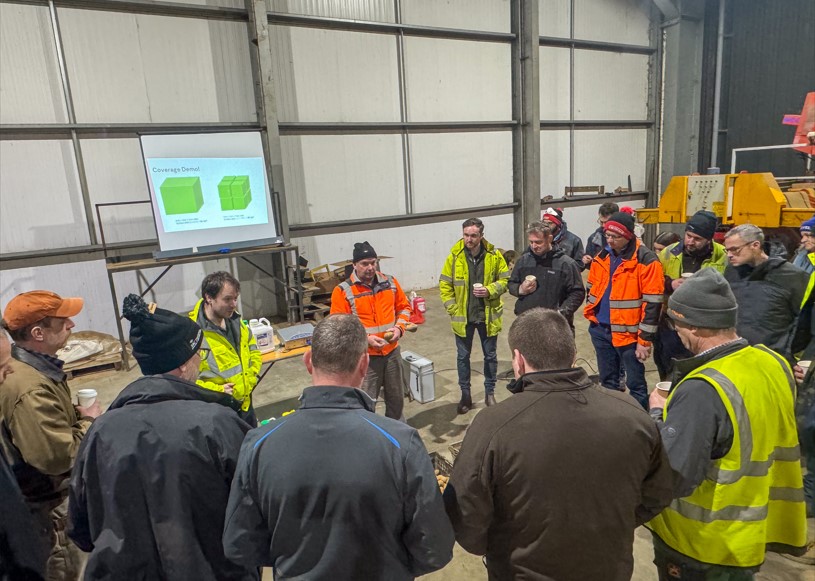
Those concerns were the focus of a recent tuber disease workshop hosted by Fortrie Farms near Ellon, Aberdeenshire.
Organised for seed growers, it brought together researchers from SAC Consulting, industry specialists and growers to discuss the latest evidence on tuber-borne diseases and the tools available to manage them.
The workshop was part of a series of regular meetings and events that are held for the benefit of members of the SAC Association of Potato Producers (SACAPP).
Darren Wonnacott, a tuber seed treatment specialist with Frontier Agriculture, has seen increasing evidence that some tuber diseases are becoming more common.
“I’ve been doing this for 23 years and I’ve seen a lot of things change. We’ve certainly seen increases in Fusarium and dry rot issues over that period, particularly in ware crops,” he said.
While no single factor is responsible, Darren believes changes in variety choice, storage duration and harvest conditions are all contributing to the problem.
“A lot of the newer processing varieties are very thin-skinned and prone to damage,” he explained.
That damage can create ideal entry points for pathogens, particularly Fusarium species responsible for dry rot, and the challenge for growers is that symptoms often develop slowly.
“You won’t necessarily see it immediately as a seed grower, but when those crops are planted, we can see losses in the field,” notes Darren.
The issue is becoming more apparent because, over recent seasons, potatoes have been pending longer in storage than they once did.
Challenging market conditions have resulted in crops remaining in store for extended periods, providing more opportunity for latent infections to develop into visible disease.
At the same time, dry harvest conditions have exacerbated bruising and skin damage, creating additional opportunities for infection: 2025 was a prime example.
Despite concerns over disease pressure, relatively little seed receives post-harvest fungicide treatment.
Drawing on SASA’s Pesticide Usage Survey (PUS), potato specialist Kyran Maloney of SAC Consulting highlighted that treatment use is lower than many might think.
The figures suggest relatively few seed crops receive post-harvest treatment, despite the regular occurrence of Fusarium, silver scurf and other tuber-borne pathogens.
That evidence generated considerable discussion among delegates but Kyran stressed that this does not necessarily mean more crops should automatically be treated.
“Seed treatments are about managing risk. They’re not always necessary, but where you’ve got disease present or conditions that favour disease development, they can be very valuable.”
For Darren, part of the challenge is that many seed treatments are applied at first grading, by which time tubers may already have spent many weeks in store.
The ideal is to apply treatments as soon as possible after harvest, but this isn’t always practical, he said.
Most seed businesses aren’t set up to treat crops before entering store or want to wait until the ware fraction has been graded off first. As a result, first grading is often the most practical opportunity. However, Darren notes that these products are protectants rather than eradicants.
“They won’t reverse infections already established, but they can protect fresh wounds created during handling and grading and reduce the risk of further disease development as seed moves through storage, transport and onto customers’ farms.”
Rather than being an either-or decision, Darren sees treatment as part of a wider risk-management strategy.
Kyran agrees that decisions should be based on risk assessment rather than waiting for symptoms to appear.
“Once you’ve got disease in store, you’re really on the back foot. The aim is to reduce that inoculum before it becomes a problem,” he said.
Survey work being carried out by SAC Consulting is helping to build a clearer picture of the pathogens affecting potato crops in store.
SAC’s Verena Schmidt explained that growers are often dealing with multiple pathogens simultaneously rather than a single disease problem.
Fusarium species remain among the most frequently identified causes of tuber rot, while silver scurf continues to be one of the most common skin blemish diseases affecting seed and ware potatoes.
Black dot, skin spot and bacterial rots also feature regularly in diagnostic samples with symptoms often looking similar.
“Without proper diagnosis, it can be difficult to know exactly what you’re dealing with.”
The work has reinforced the importance of accurate diagnosis when assessing risk in seed stocks and making subsequent treatment decisions.
Not all diseases respond equally to the same chemistry and understanding which pathogens are present can help growers select the most appropriate management strategy.
The findings also highlighted the importance of an integrated approach.
“No single measure will solve every disease problem. Good handling, hygiene, storage conditions and targeted treatments all have a role to play,” said Verena.
Another interesting piece of work discussed during the workshop focused not on the potatoes themselves, but on the environment in which they are stored.
Working with Certis Belchim, SAC Consulting has been investigating the role that store dust and debris may play in harbouring disease inoculum between seasons.
Dust samples collected from two commercial stores were analysed to identify the presence of pathogen DNA.
The results revealed several important potato pathogens suggesting that stores themselves are reservoirs of inoculum that can carry disease over from one season to the next.
While the findings do not necessarily prove that disease will develop, they do demonstrate that pathogen material can persist within stores long after a crop has been removed.
This reinforces the importance of store hygiene as a core component of disease management.
Essential measures are removing debris, cleaning ventilation systems and carrying out thorough disinfectant programmes with products like Jet5 before introducing a new crop.
For growers facing prolonged storage periods or recurring disease problems, hygiene may be one of the most cost-effective interventions available.
While good storage and hygiene practices are essential, delegates agreed that seed treatments continue to have an important role to play.
Products based on active ingredients such as imazalil and thiabendazole have been used for many years to help protect tubers from storage diseases, particularly Fusarium dry rot and silver scurf.
Gavel is widely used in situations where growers are seeking protection against storage diseases and to maintain tuber quality during prolonged storage.
Storite Excel provides an alternative mode of action and is often used to broaden disease control or strengthen resistance management strategies.
According to Darren, the choice of treatment should depend on disease risk, varietal susceptibility and intended market.
“If you’ve got a high-risk situation, there can be a strong argument for using both actives. You’ve got two modes of action, and your resistance management is built in.”
Kyran agreed that higher-risk situations may justify a broader approach.
“There are several Fusarium species involved in dry rot symptoms, and we know there have been resistance issues reported historically in some populations,” he said.
“If you have a genuinely high-risk situation, there is certainly an argument for including thiabendazole alongside other chemistry.”
However, he stressed that treatment decisions should always be based on risk rather than routine application, with not all stocks needing both actives, one active, or even a fungicide treatment at all.
“That balanced approach reflects the wider industry move towards more targeted crop protection and integrated disease management,” said Kyran.