
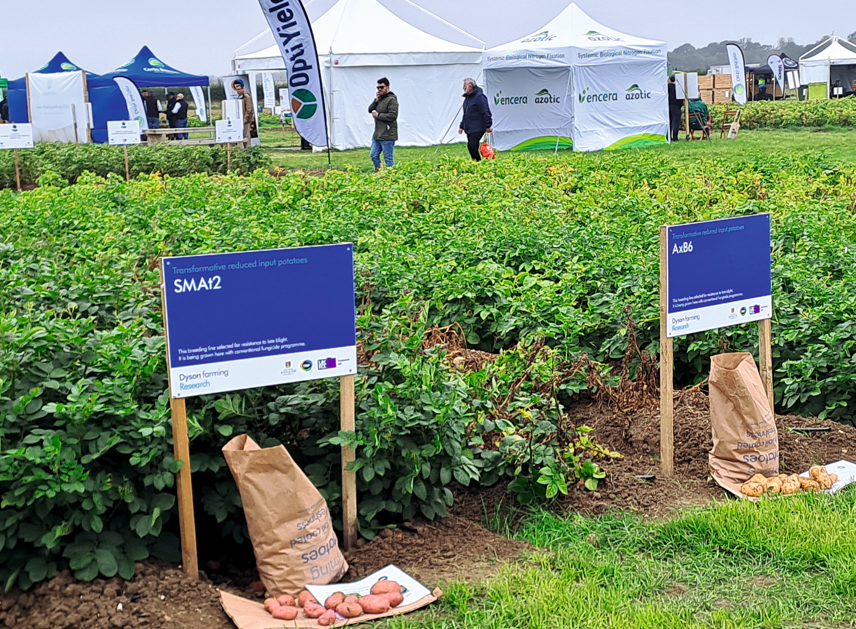
TWO seasons into the three-year Innovate UK-funded Transformative Reduced Input Potatoes (TRIP) Project, the on-farm trials continue to demonstrate the importance and positive effects of adding supplementary soil microbial mixes during planting.
Seed germination rates and early crop establishment have been seen along with longer-term benefits to crop vitality and yield.
The project involves a consortium of key industry, academic and farming partners, including Dyson Farming, Bangor University, The James Hutton Institute, Light Science Technologies and Emerald Research Ltd. The farm-scale and replicated trials are taking place through the farming partners SDF Agriculture, F G Pryor and Son Ltd, Colwith Farm Potatoes Ltd and CP Richards & Son Ltd.
Emerald Research Ltd (ERL) CEO Simon Fox explains “Over the winter months, the soil’s natural microbial colonies are challenged by flooding and persistent waterlogging as well as freezing temperatures. This follows them having survived in the face of overused input factors such as fertilisers, nematicides and insecticides.”
He said research has long correlated the synergistic relationship between plant roots and soil microbials in beneficial processes such as nutrient exchange, growth stimulation and increasing disease resistance and, even with the recent renewed emphasis on soil health and the inclusion of organic matter, naturally-occurring soil microbial colonies are still under pressure to survive and be useful.
Over the past two seasons of trials, the TRIP project has evaluated the use of a microbial mix that have been developed using combinations of native UK microbial species, because they are adapted to the varied soil and environmental conditions of the UK. These formulations contained mixtures of many synergistic and beneficial species because each will flourish in different conditions and support the positive effects of others.
The microbial mix also included a food source for the microbes and a number of complementary biostimulants, which also have a direct beneficial effect on early growth and nutrient mobilisation in the root zone. These were combined to fortify and feed the microbes, while the tubers started to produce roots, ensuring that the newly-introduced microbial colonies could survive and thrive until the tuber produced roots and the microbes had a plentiful natural food source.
The 2024 trials re-affirmed the project’s findings from the previous year. Typically, the four trials in 2024 (three in Cornwall and one in Lincolnshire) tested four different treatment regimes (see table).
Throughout all four trials, a significant yield uplift of between 25% and 32% was seen where Consortium Plus had been used instead of a standard seed dressing.
These results not only support the need to increase the naturally-occurring colonies at planting with UK derived microbes, but also the importance of keeping them fed during the first few days while the tuber begins to root and to continue supporting them in the intervening two or three weeks while roots develop. After that, the crop will be producing enough root exudate to maintain the colonies without additional support.
Lastly, the inclusion of these with foliar nutrients has allowed those carrying out the trials to reduce soil-applied fertilisers by 50% while maintaining yields, providing another positive benefit for the soil’s future microbial colonies.
The 2025 trials are currently being developed in conjunction with the project’s farming and academic partners and will continue to evaluate the benefits of using a microbial mix at planting along with the longer-term effects on crop yield.