
IN 2021, fourth generation young farmer Tom Harrison took on the reins of his family’s business, which has been growing potatoes since 1963.
Managing more than 1,200ha with 460ha of potatoes grown on rented land spanning the North Norfolk coast, the home farm of HDF Farming Ltd is in Trimingham, near Cromer.
The family grows seed potatoes under contracts with different seed companies. They also grow potatoes for processing, supplying Lamb Weston and Albert Bartlett. In addition, they supply pre-pack potatoes to supermarkets and sell some potatoes directly to local markets under their own brand.
With a wide range of potatoes being grown across rented land, Tom and the farm face regular PCN challenges.
Through working with experts, including independent agronomist Simon Alexander, Alistair Neill from Prime Ag and Alastair Ross from Frontier Agriculture, Tom is actively looking at non-chemical approaches to PCN management.
As such, he uses a combination of IPM strategies to help spread risk and bolster the chances of potatoes being protected from Globodera rostochiensis and Globodera pallida.
The first step in his battle plan is having a thorough understanding of the PCN pressures in every single field.
“Although you can’t be 100% accurate with the reading across an area of over 10,000 square metres and only 200g of soil, sampling every single field remains the first step for us to work out PCN burden and forge an IPM plan that won’t decrease yield,” said Tom.
“If a field is deemed to be clean, we put in a variety with low resistance, therefore the chance of multiplication is very low owing to no findings in the samples. If we find higher counts, around one to five eggs per 200g soil sample, we would be likely to use a variety with good resistance and partial tolerance. In this instance Amanda works well.
Sometimes a half rate Nemothorin is still required as a yield protection depending on the field history, he said.
“This strategy assures when the land comes back into potatoes in eight years’ time that we shouldn’t run into any issues. If higher egg counts show above this reading, five eggs and over per 200g of soil, this is when a variety such as Elland is used to achieve reduction in PCN counts as it has good resistance as well as high tolerance. However, a full rate of Nemothorin is still required in this instance to guarantee that yield and ensure a positive return.”
Tom explained how bio fumigation is used to reduce PCN development.
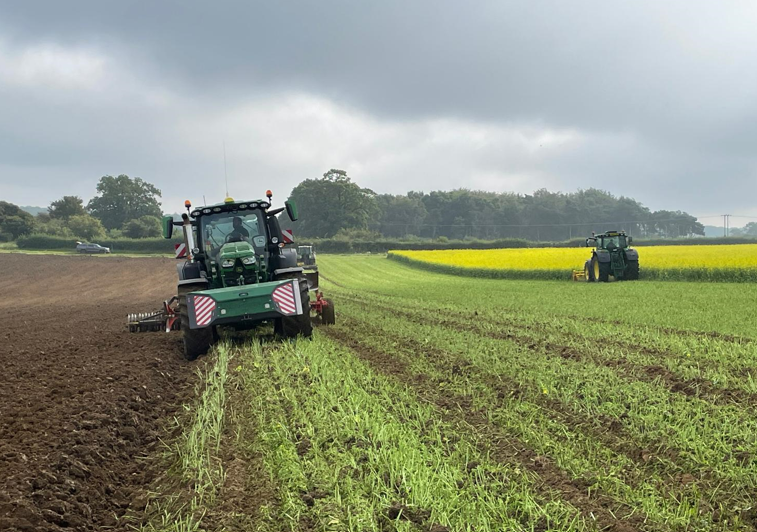
“We use hot mustards with a 50/50 blend of Caliente and Caliente Rojo, which are mulched when around 50% of the crop is flowering. This process releases Isothiocyanates as well as other products of hydrolysis into the soil which supresses the PCN.
“Good establishment is key, and the aim is to produce as much biomass as possible before the mustard starts flowering. For best results, the soil needs to be moist and the temperature needs to be above eight degrees when mulching and sealed.”
“Ensuring all steps of growing the fumigation crop are done correctly is key to reducing PCN numbers. We have seen mixed results and the majority of these is down to how well established the crop is.”
Explaining why this process as part of his IPM strategy, Tom said: “I like to try to use bio-fumigation as a non-chemical approach to managing the pest, but as the effect can be hard to monitor, it’s always used as part of a mix of practices.”
Using Solanum sisymbriifolium – a member of the potato family – as a trap crop is another strategy he has trialled.
“The roots’ release exudates that encourage the PCN to hatch but they cannot multiply on the roots. This, therefore, leads to a reduction in the population,” said Tom. “We’ve seen a 30-40% reduction in PCN using this method, however, there are some key timing considerations.
“We were lucky enough to be following a carrot rotation, which was key, as Solanum sisymbriifolium is most effective if planted in early summer – ideally June – which doesn’t work with all rotations. However, with autumns becoming more open, there may be an opportunity to extend the drilling window which may lead to more opportunities to fit this in the standard rotation.
“As with bio-fumigation, trap crops also reduce pest levels, but their use can be costly – we are looking at £750/ha before the soil sees a potato,” he added.
Tom said the farm considers nematicides as an insurance policy for the crop and the investment.
“We do use nematicides where required in fields with higher PCN burdens, which is representative of between 20-30% of our total crop,” he said.
Reflecting on his experiences, Tom highlights what he believes is essential for a successful IPM strategy to manage PCN.
“A combined approach, using the right IPM methods tailored to each field and level of PCN burden is crucial,” said Tom. “Equally important is selecting the right varieties and thoroughly sampling all your land to understand the Plant and financial risk due to PCN.
“It’s worthwhile making sure you can access as wide a range of varieties as possible so you can pick what you need when it comes to yield, margin or cleaning up land for your next rotation in eight years’ time.”
“Though PCN management is challenging at times, I take comfort in the fact that the industry has learned a lot and moved on significantly in the past few years with new technologies developed and more varieties becoming available.”
“We are conscious of the best practice requirements on the use of granular nematicides as stated under stewardship and doing our best to help protect them and to minimise their impact on the natural environment,” said Tom.