
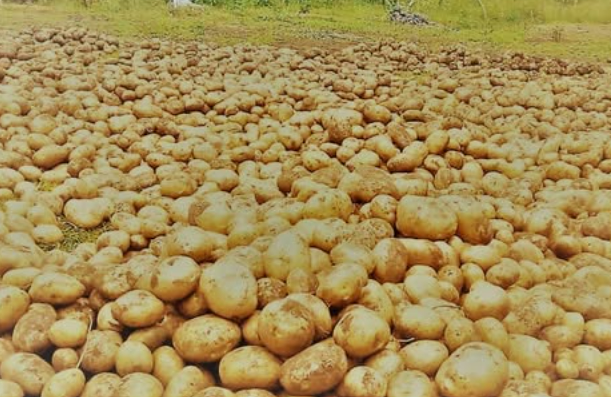
THE Unggai-Bena District Development Authority (DDA) in Papua New Guinea has disbursed K16,000 to the Fresh Produce Development Agency (FPDA) for acquiring early-generation elite potato seeds.
These seeds, consisting of Generation 1 (G1) Sequoia and E2 potato varieties, aim to boost ware potato production in the district, according to Fresh Plaza.
While potato production exists in Papua New Guinea, particularly in the Highlands, it’s not as dominant as sweet potato, and it has faced challenges from blight. But more resistant varieties are now being introduced.
In Papua New Guinea, sweet potatoes, locally known as “kaukau,” are the most important food crop, providing a significant portion of the country’s dietary energy and serving as a vital income source for smallholder farmers, particularly in the Highlands region. While potatoes are also grown, sweet potato dominates as the staple food.
Papua New Guinea news source the Post Courier reported earlier this year on a study being carried out to improve the country’s potato production.
It stated that potato growing is challenging because of a progressive decline in quality and quantity of materias, with new pests and diseases emerging that were reducing yields.
The National Agricultural Research Institute (NARI) undertook a study to address the challenge, exploring the potential of using rooted apical (tip) cuttings instead of mini-tubers to help increase planting material.
The projedct was led by Highlands Regional Research Centre in the Eastern Highlands between 2022 and 2024 and showed promising results, with one variety showing particularly good output traits. Further trials are being undertaken.
Photo: UNDP