
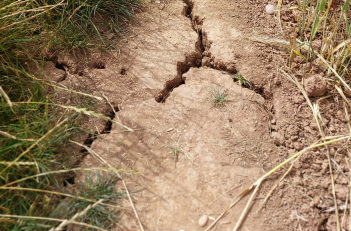
As UK agriculture copes with its driest spring in decades, researchers from The James Hutton Institute have written a report for the British Ecological Society (BES) detailing how their science is playing a pivotal role in helping the UK navigate this crisis and prepare for the next.
The UK is in the grip of one of its most severe droughts in living memory. Spring 2025 is officially the driest since 1956 and potato crops are already showing signs of stress, with yields expected to plummet owing to dry soils and high temperatures.
Hutton scientists see improving the drought tolerance of crops as a top priority. Through plant breeding projects, they are exploring a range of approaches, some traditional, some cutting edge, to understand how different varieties perform in specific regions which allows scientists to tailor crops to local conditions.
Scientists are selecting varieties with traits like deeper roots and longer-lasting green foliage (“stay-green” traits). They are also turning to landraces, traditional varieties naturally adapted to dry conditions, for inspiration. Using advanced methods like marker-assisted selection and genomic selection, scientists can predict drought tolerance using genetic data. Genome-wide association studies help pinpoint the exact genetic regions linked to drought resilience.
They are applying cutting edge approaches such as gene editing and precision breeding to tweak specific genes that control how plants respond to water stress, and remote sensing using drones and sensors to track plant health and fast-track the development of climate-resilient crops in field conditions.
Dr Tracy Valentine, Research Leader, Plant: Soils Interaction at the Hutton, said: “Climate resilience isn’t just about reacting to crises, it’s about anticipating them, adapting to them, and innovating beyond them. Whether it’s through smarter farming, better water management, or cutting-edge genetics, the path forward is clear, and science has a critical part to play in our future sustainability.”
Drought isn’t just a growing issue. River flows in places have dipped to their lowest levels since records began in 1958, putting freshwater wildlife and habitats at serious risk. Eastern Scotland in particular is experiencing record-low groundwater levels, prompting emergency interventions like transporting water to remote communities. When rain does come the degraded soil status increases the risk of large-scale water run-off and flooding.
Wildfires, once rare in much of the UK, have surged in frequency and intensity. More land has already burned this year than in any previous full year. Climate scientists warn this may be the new normal.
The Hutton scientists warn that the next few weeks will be crucial. “Without significant rainfall, the UK could formally enter a state of drought, triggering further restrictions. Looking further ahead, climate models suggest this won’t be a one-off. Droughts like this are likely to become more frequent, longer and more intense.”