
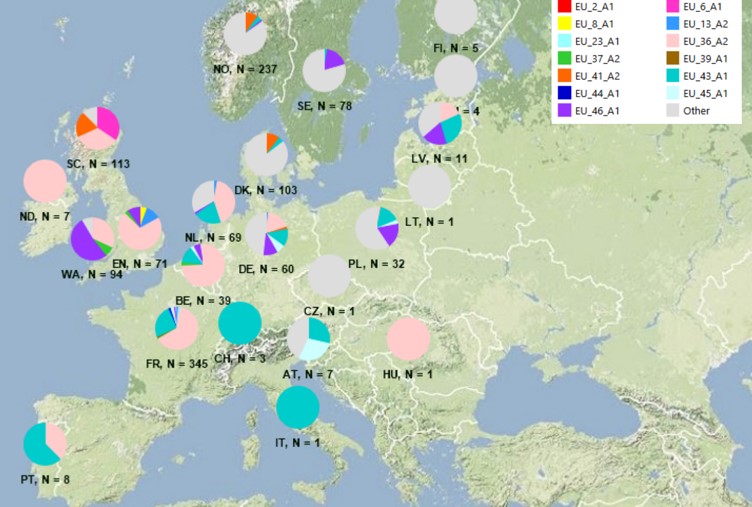
MORE than 1,200 samples from sponsors across Europe were genotyped but sample numbers were much lower in some key countries, according to Dr David Cooke.
“For example, the Netherlands, Germany and Belgium collected over 1,000 samples in 2024 but only 166 in 2025. This smaller sample means results may be influenced more by trial sites or specific local outbreaks.”
The overall frequency of EU43 had decreased from 23% in 2023 to 9% in 2024 with a slight increase to 12% of all early samples in 2025, and a marked variation between countries
The Netherlands reported 20%, from a sample of 69. Germany reported 12% from a sample of 58; Belgium 13% from a sample of 30 and Denmark 4% from a sample of 103. France had a notable increase from 10% to 25%, from a sample of 345.
Although the frequency of EU46 sampled across European crops increased from 4% in 2024 to 7% in 2025, again there was considerable regional variation. The strain decreased in the Netherland to 1%, from a sample of 69, while it increased in Belgium and Great Britain, to 5% from a sample 39 and 20% from a sample of 278 respectively.
It was not detected in Denmark, from a sample of 103.
Key findings so far are:
With EU36, there was a fall in overall frequency from 52% in 2024 to 34% in 2025. Once more, there was considerable regional variation, with it making up 43% of samples in the Netherlands, 64% in France and 74% in Belgium. Bar a single sample in Denmark, it was not found in the Nordic countries.
Other blight clones of note included:
Around one third of samples fell into the highly diverse “Other” category, double the proportion seen in 2024. This is owing to a higher proportion of 2025 samples from northern and eastern regions that are not dominated by clonal populations of P. infestans. In Denmark and Norway, for example, 85% of samples were classed as “Other”. Data from many years shows a consistent incidence of highly-localised and ephemeral multi-locus genotypes that do not reach the threshold for being named as clones. This is consistent with oospore inoculum in the soil that germinates and causes.