OPTING for a variety that is the next step up from one you already know works well is a good strategy for those potato growers looking for new options, according to Andrew Goodinson, who says the main question they should ask themselves is ‘Does this variety produce better quality tubers than the ones we are currently growing?’.
Ultimately, growers are always looking to maximise the profitability per hectare of their crop, so they need to think in terms of yield and quality – and getting the specification their customers want, he stressed.
“Decisions on which varieties to grow need to strike a balance between the different traits demanded by customers and the agronomic needs of the fields and systems you use. Getting it right is key to success. We really need to build closer links between the customer, breeder and grower. For example, if growing for the processing market, many of your customers are under pressure to look further at sustainability criteria and environmental impact.
“Building dialogue and closer relationships can make a real difference to outcomes.”
When visiting variety trials, after checking the tuber specification (size) and traits such as tolerance and resistance, Andrew suggests looking at how well varieties are coping with weather conditions.
“It is also a good idea to check how well they fit with your soil type and your farm history – for example, if you have fields at risk of very dry soils, or high numbers of FLN or PCN.”
There is a large pool of potentially-suitable varieties for the fresh sector, he observes, but notes that growers in Britain tend to be limited to growing the same few, because their visual and culinary attributes have already won acceptance with consumers, and therefore supermarkets.
“As a result, it’s difficult to get the fresh sector to accept varieties with agronomic and environmental benefits that also have good culinary attributes.”
Andrew looks for varieties capable of uniform growth and yield, even when the season is challenging.
“A good root system is able to scavenge for nutrients and water and reduce the impact of potential stresses, so the crop can perform better even in difficult seasons.”
He notes that an extensive root system helps plants cope with disorders such as foliar diseases and damage caused by free-living nematodes (FLN) and potato cyst nematodes (PCN). Ideally, the variety should also be tolerant and/or resistant to these pests.
“In addition, good roots can help us manage the amount of inorganic fertiliser needed, helping to keep input costs down.”
As yield remains crucial, he recommends looking for optimum eye and stem numbers, as these help ensure a more uniform crop.
“We prefer each seed to have three stems. We also need varieties capable of reaching full canopy as quickly as possible, to make a large foliage ‘solar panel’ that increases photosynthesis and helps the crop reach its yield potential.”
Haulm longevity also plays a role: The longer the haulm grows, the better the potential yield. It is good, however, to see some senescence before making harvesting decisions, as this indicates the crop is reaching its natural conclusion.
Other quality attributes include breeding to reduce tuber defects such as internal rust spot, and ensuring even distribution of sugars, carbohydrates and dry matter through the tuber.
He also highlights that tubers need good skin characteristics, able to withstand harvesting conditions and store well.
“Each specific market sector has its own criteria for tuber shape – for example, the roundness of tubers for the crisp market – so we need to aim for uniformity within these criteria for the markets we’re supplying.”
He goes on to say that work still needs to be done to develop varieties with tolerance and resistance to soil-borne and foliar pests and diseases.
“We need to look harder at genetics to find new varieties with tolerance to viruses such as Potato Leaf Roll Virus (PLRV), a persistent virus transmitted by aphids. We also need varieties with resistance and tolerance to pests such as potato cyst nematode (PCN) and free-living nematode (FLN).
“The amount of land infested with PCN and/or FLN is increasing, so varietal tolerance and resistance is becoming critical.
“This is even more important in years where crops are planted into less-than-ideal soil conditions, leaving them without the root system or biomass to reduce the effect of these pests.”
Some processors are encouraging their growers to plant varieties which can be planted and lifted earlier, and which are resistant to some strains of the PCN genotype Globodera pallida, compared with other varieties in the sector.
Seed efficiency is also important, he observes, noting that varieties with more eyes per tuber can potentially be cut in half – in a similar way to Shepody – increasing the number of seed pieces per tuber.
Storage remains an important aspect of the industry, and with high energy costs alongside the need to reduce carbon footprint, long dormancy has become another important trait for the future.
While new varieties are the future for the industry, convincing customers of the benefits of agronomic advantages is key, said Andrew.
Processors appear to be aware of the challenges growers face in the field, and of the need to address them alongside the drive for better sustainability and a lower carbon footprint, but getting the fresh potato sector to accept and adopt new varieties is proving more challenging.
“We need more discussions between growers, buyers and marketers in the fresh sector to bring this about. We need to build awareness of the potential advantages of new varieties with agronomic qualities – such as disease resistance – and the resulting need to use fewer plant protection products. These benefits should be promoted at the point of sale.”
Looking to the future, he reflects on whether the sector should look to plant genetics rather than inputs, taking advantage of precision breeding to develop varieties with the same culinary characteristics but greater agronomic benefits and lower input needs.
Prior to making decisions on which varieties to grow, Andrew recommends visiting the seed supplier to view the crop in-field or in-store.
“It’s often easier to choose seed that meets your specifications if you can go and see it growing in the field. Building better communication with the seed grower also provides an opportunity to discuss potential seed treatments, and whether they can be applied before transport.”
Potato crops were looking good in July, with many receiving micronutrients and biostimulants to keep them going and reduce stress. However, biostimulants can only do so much, and crops still need sufficient water, Andrew emphasises.
“If we’re thirsty, we often don’t want food – and likewise, if there’s a water deficit, the crop is unable to take up nutrients. Not all potatoes are irrigated, and for those that are, if there are further long periods without rain, some water authorities will issue irrigation restrictions.”
This year, crops in the west have tended to have higher tuber numbers than in the past three years. “As the plants are healthy, they’re better able to look after their tubers, and we need to maintain this by ensuring they have sufficient moisture.”
He notes that most potato crops this year have a good canopy that meets between the rows, helping to hold on to moisture and keep soil temperatures lower. This has been crucial during the heatwaves of May, June and July.
“Although the top leaves are suffering from scorch, the underside of the plant is still green, and this is helping the plants cope better with the heat. Where the canopy opens up, or doesn’t meet across the row, the lower leaves appear more susceptible to damage.”
So far, he adds, it has been a low-blight season, partly because there was little inoculum, thanks to the dry conditions last year.
Looking back to the start of the season, he notes that the way seed potatoes were grown in 2025 has had an impact on the 2026 crop.
“The dry conditions last year, alongside the very warm autumn, resulted in lower tuber numbers and a higher physiological age in seed potato crops, and we found a lot of instances of skin disease, including black dot and silver scurf.”
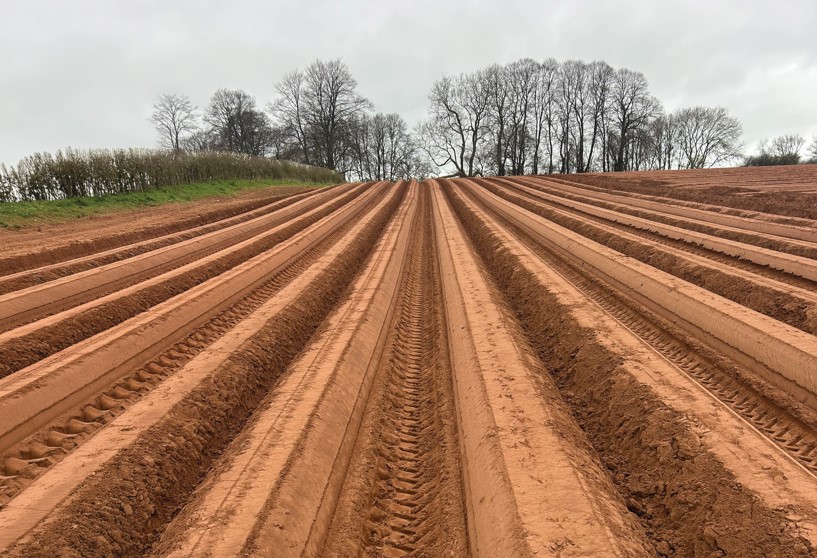
In 2026 soil conditions at planting were good, although temperatures were still low, so emergence was slow, and Andrew has seen cases of little potato disease, rhizoctonia and chain tuberisation.
“Many growers found themselves constrained by cash flow as fuel and fertiliser prices rose in response to the conflict in the Middle East. This made them think hard about cultivations, and in many cases the soil was cultivated less than in other years, which is a positive outcome.
“Other changes this year include more growers opting for placement fertilisers, particularly in the western counties of England, where soil phosphate levels are high. Seed potato prices also rose, so in many cases more attention was paid to getting spacings and populations right.”
Andrew has been trialling microbial products, seaweed extracts and biostimulants in potato crops over a number of seasons, looking at their role in helping crops cope with both biotic and abiotic stress through the growing season.
“Biostimulants work by stimulating or enhancing the crop’s natural processes, which may help improve environmental tolerance, increase nutrient-use efficiency, and enhance plant growth.
“It’s similar to giving colostrum to a new-born lamb or calf, to jump-start its immune system.”
Biostimulants work by prompting a reaction from the plant, and different products have activity at varying stages of the growth cycle – they can affect germination, root biomass, vegetative growth, flowering and fruiting.
However, he warns, they are an integral part of the whole agronomy programme and should not be viewed as a silver bullet.
Andrew also notes that biostimulants can help ameliorate abiotic stress caused by weather conditions, such as heat stress. “Some varieties don’t cope well with heat stress, but our trials showed that judicious use of an appropriate biostimulant improved yields by nearly 20% compared with the control.”
Trials exploring the effects of different strains of Bacillus at planting are being used to try to increase soil microbiota around the seed.
“When these are used alongside other nutritional supplements, with applications made at hook stage or tuber initiation, this can help increase the number of viable tuber sets and extend the life of the green canopy, increasing yield.
“Combining biostimulants and foliar nutrient programmes can also significantly reduce the need for overall fertiliser inputs and costs, as well as cutting carbon footprint.
“Many biostimulants cost between £20–30/ha per application, and two or three applications may be made during the growing season. In terms of return on investment, each treatment costs about the same as a single blight spray.”
To help customers get the most from their crops, Hutchinsons has been testing fertiliser placement with microgranules on arable crops for around ten to twelve years, and Andrew has been trialling this system on potatoes for five years.
“The aim of the trials is to see how much of the nutrients we can utilise from the soil, as this can potentially reduce the amount of purchased fertiliser we need to apply.
“In addition, because soils in the west have very high phosphate indices – over three – we’ve been replacing granular phosphate applied pre-planting with a microgranular fertiliser,” says Andrew, noting that these products provide 10% N, 40% P, 2% Mg and 2% zinc, and cost between £40–55/ha.
“These products bridge the gap between biostimulants and fertilisers, and we’ve found their application helps roots grow to find the phosphate the young plant needs.
“As always, we have plenty of phosphate ‘in the freezer’, but we need to get it to the table, and these products help improve its availability. Like all inputs, they’re part of the whole picture, and these products need to work together as building blocks.”