
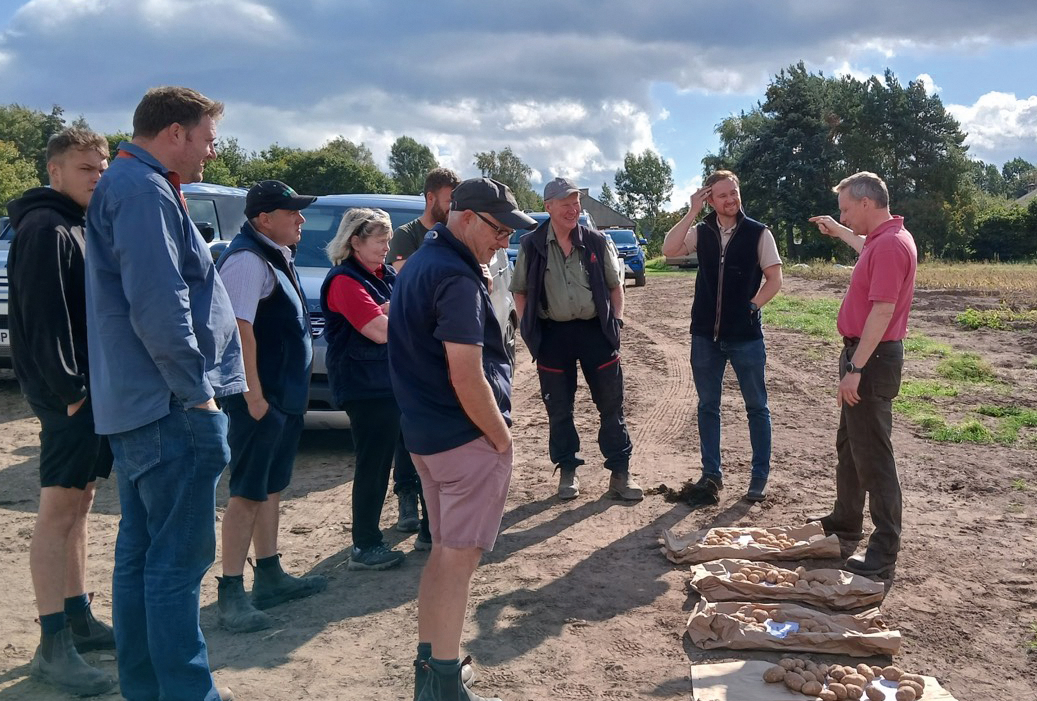
WITH continued research and wider adoption, Scottish potato growers may soon have an effective new approach to boosting tuber numbers in the coming years, recent work has shown.
A potato trial has shown promising results in increasing tuber numbers for seed potato crops, particularly for the popular Innovator variety.
Conducted by SAC Consulting (part of Scotland’s Rural College), the trial demonstrated a significant boost in seed potato tuber numbers using biological products and agronomic interventions, a crucial development for seed growers aiming to maximise tuber yields.
The trial was spearheaded by Steven Jack of Organic Potato Growers, with financial backing from potato processor Lamb Weston. The trial was also encouraged by members of the SAC Association of Potato Producers (SACAPP), a knowledge exchange network.
Senior Potato Consultant at SAC, Kyran Maloney, has been leading the trials.
He said: “Steven Jack outlined a brief that resonated with many regional seed growers. He wanted to test products and techniques to increase tuber numbers on seed crops and with the additional guidance of Agrovista Agronomist and North Scotland Area Manager, Andy Steven, we trialled various treatments related to planting systems and some product applications.”
Kyran said the seed potatoes were cultivated in de-stoned beds using a split-plot trial design with quad planting in traditional ridges, allowing more space for root expansion. Existing research indicates that this method enhances tuber numbers. The trial also incorporated three-row beds, a common growing practice.
Six different approaches were tested on two varieties, Innovator and Ivory Russet, as follows:
The results showed that increasing the seed rate had little impact. However, other biological and agronomic interventions proved more effective. Luxor increased tuber numbers by over 30%, Phosta led to a 20%+ increase while tipping and covering techniques boosted tuber numbers by more than 24%.
“These statistically-significant results are highly relevant for regional growers,” said Kyran. “Increasing tuber numbers is vital throughout the supply chain, and growers are also exploring ways to enhance sustainability, reduce ‘field generation,’ and lower aphid vectored virus exposure – key factors in maintaining high health status for seed potatoes.”
Calfite Extra applications also showed an increase of about 13. However, the he trials showed no statistically-significant impact on Ivory Russet.
“It’s not easy to explain why interventions worked in one variety and not the other,” said Kyran. “We’re keen to run similar trials in future seasons to see if we can replicate the result.
With commercial potato varieties increasingly bred for processing, their suitability for seed production has become a challenge, as they naturally produce fewer tubers. This is counterproductive for seed growers who prioritise high tuber counts.
Andrew Cromie of Unium Bioscience said maximising tuber numbers is essential for seed crops.
“Recognising this issue, the trial was designed to assess the impact of two key products – Calfite Extra and Luxor – on seed potato production. These products enhance phosphate availability and provide biostimulants to support tuber formation and overall plant health,” he said.
“It’s crucial to identify which varieties respond to biostimulants. In other trials we have seen significant increases in tuber numbers with Calfite Extra. The interaction of variety and treatments is interesting, and we are keen to explore this further to see if this is consistent year to year.
“We’ve also developed LuxiCal, a blend of Luxor and Calfite Extra, and are eager to explore potential synergies for boosting tuber numbers. Being part of these trials allows Unium Bioscience to provide well-informed guidance on maximising product benefits.”
The Scottish trial demonstrated evidence for an increase in tuber numbers with the application of Luxor, Phosta and tipping and covering techniques in at least one variety.
“These results are beneficial not only for Scottish growers but also for UK-wide salad crop producers who aim to increase tuber numbers for punnet potatoes,” said Andy Steven, adding that ongoing trials will be essential to validate these initial results.