
DESPITE a fall in levels found in 2024 seed potato crop inspections in a major British seed growing region, transmission of aphid-borne virus diseases remains a major industry challenge.
To maintain the downward trend this year, seed growers across the country are advised to keep a close eye on national and local aphid monitoring services and be ready to commence control programmes as soon as vectors start to move.
With ware crops in the ground by the third week of March in the traditionally-early areas of Ayrshire, and pockets of Morayshire, Fife and East Lothian, most seed growers made a start to planting in the first week of April, according to SAC Consulting Senior Potato Consultant Gavin Prentice.
According to the aphid flight forecasts published by SASA (Science and Advice for Scottish Agriculture) and Rothamsted Research, the first aphids are predicted to arrive in Scotland on or around May 29th, which is about two weeks earlier than average.
In England, first flights are predicted to be almost two weeks later than average, on or around May 15th.
“Predictions of early aphid flights in Scotland are a concern, but a favourable spring means that crops should be in the ground early in good time, and many could emerge before the first problem aphid flights occur,” Gavin said.
With the highest risk of virus transmission occurring between crop emergence and stable canopy, growers need to be on the ball with their protection programmes, he adds.
Levels of the persistently-transmitted virus potato leaf roll virus (PLRV) have increased in Scotland in recent seasons, while non-persistently transmitted virus potato virus Y (PVY) and its variants are still an issue across potato production regions.
PVY currently poses the main threat in English seed potato producing areas in Yorkshire and East Anglia.
After two seasons of increase, Scottish Seed Potato Classification Scheme (SPCS) results for 2024 show a decrease in the percentage of crops downgraded or failed because of the presence of PVY or PLRV at inspection. This points to a potentially reduced virus burden this season.
“In 2024, 8.4% of Scottish seed crops were downgraded for virus and 0.8% failed; the previous year 15.4% were downgraded, and 1.8% failed.
“That’s essentially half the amount of virus physically found during inspections. It’s still much higher than historical levels though, so despite the trend going in the right direction, there is much more that needs to be done,” Gavin said.
A rigorous integrated pest management (IPM) approach, outlined in the Scottish Aphid Borne Virus Working Group (SABVWG) ‘Six Steps to ensure effective virus management in potato crops’ document is crucial for the effective management of aphid vectored viruses.
The guidelines were updated last month and advice on removing virus-infected plants through a range of measures, including early rogueing is amongst the recommendations.
This is an effective disease management strategy if infected material can be removed before aphid vectors are present in significant numbers, but there are limitations – symptoms of within-season (primary) transmission are often not seen.
A new asymptomatic strain of PLRV, recently identified by James Hutton Institute (JHI) virologist Dr Eugene Ryabov, may potentially have contributed to the rise in virus levels seen in recent seasons, says Gavin.
“That said, researchers at JHI are investigating if there have been changes in PLRV, as so far we know very little about its variants in Great Britain,” he said.
The guidelines also advise growers to “know the enemy” and act on monitoring information from the nationwide suction trap network, alongside local yellow water trap data, to anticipate aphid flights and keep track of active aphid species.
Services such as SASA’s website and SAC Consulting’s weekly in-season pest and disease alert can also help to keep members up to date in terms of insecticide management and aphid risk, adds Gavin.
Use of a targeted spray programme is advised as part of an IPM strategy – using plant protection products when target aphid species are flying and, importantly, covering the full growing season.
“This is something that we advise growers to adhere to, because while the risk of virus transmission is often very high at the start of the season, it can remain high come desiccation, depending on aphid numbers and species present, especially post-desiccation if any regrowth is seen.
“To target that threat with an insecticide programme, the two key translaminar insecticides we have in our armoury – acetamiprid in InSyst and flonicamid in Teppeki – are vital to control PLRV.
“Spirotetramat in Movento is also an option, but can only be applied post flowering,” says Gavin.
Certis Belchim’s Technical Account Manager in Scotland, Cristina Ruiz-Alonso, said both can be applied twice in seed potatoes, and labels stipulate a minimum 21-day application interval between each of the two individual product applications.
This means the two products should be alternated on 14-day intervals to meet this label requirement and, when used in a four-spray sequence, should provide crops several weeks’ protection against colonising aphids.
Cristina also points out that while Teppeki active flonicamid and acetamiprid in InSyst both have a translaminar effect (they penetrate the leaf tissue and form a reservoir of active substance within that leaf), both have very distinct modes of action.
Flonicamid is a feeding inhibitor picked up as the aphid probes the leaf and acetamiprid works by both contact and ingestion.
“InSyst is ideal for use at the beginning of the insecticide programme where aphids are present in the crop, as its contact activity provides rapid knockdown soon after application. With flonicamid, aphids will stop feeding within an hour of ingesting Teppeki, halting virus transmission, but death can take up to 72 hours,” Cristina said.
She adds that flonicamid is the only active substance in Insecticide Resistance Action Committee (IRAC) group 29, with acetamiprid sitting in IRAC Group 4A, so they are perfect partners for resistance management perspective, too.
Gavin believes sensible and targeted use of pyrethroids still have a place in the spray schedule, as they provide rapid knock-down of some aphid species.
However, there is resistance to pyrethroids in key vectors, including peach potato aphid, a highly efficient transmitter of both PLRV and PVY. Questions have also been raised about the effect of pyrethroids on aphids’ natural enemies.
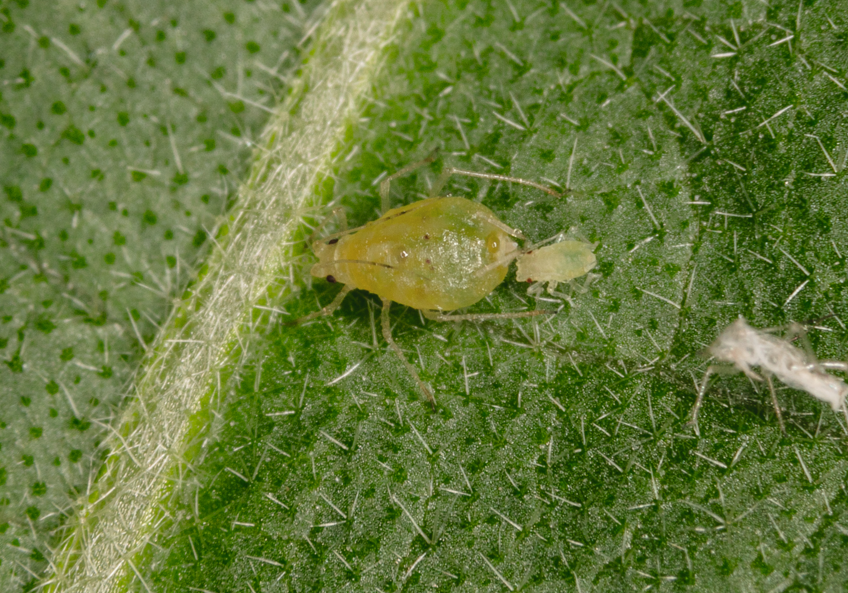
The peach-potato and potato aphid are the two main vectors for PVY and PLRV but there are also other vectors for PVY, including the glasshouse-potato aphid, black bean aphid, pea aphid, willow-carrot aphid, grain aphid and bird cherry-oat aphid.
Gavin says if you have these other probing aphid species present in significant numbers, it may be worth using a pyrethroid, although it also depends on their propensity to carry and transmit virus.
“Last year we saw quite a few black bean aphids, but their PVY infectivity index is only 0.1. However, high numbers still create a high level of potential virus pressure within the crop. Whereas, for example, peach potato aphid, has a PVY index of 1, so it’s very quick to transfer virus as it probes, so even small numbers are a concern.”
IPM methods such as mulching, mesh netting, dyes and flower strips can also play a role in virus management, but more work is needed on their use and efficacy, suggests Gavin.
“IPM is essential for aphid vectored virus management. We have good evidence that measures like mulching work if they coincide with early aphid flights, but they need to be integrated with other measures such as a robust crop protection program.
“For some other measures, we need to find out how effective they are and when best to deploy them.”
One additional tool that is attracting increasing interest is tuber virus indexing, which detects the presence of viral DNA from growing on tests or seed tubers using ELISA or PCR methods. Sampling is best conducted in the field, walking a W-shape pattern, collected between crop desiccation and harvest.
Historically, this type of testing was reserved for high-grade input seed stocks but is starting to be more widely used to flush disease out of the entire production system.
“Only time will tell what virus inoculum levels will be like this season, but we have had some positive feedback from clients who are tuber indexing, with results and appropriate management suggesting less inoculum will be going back into the ground.
“You have to be mindful that tuber indexing is only as good as the sample taken and works on confidence levels, we have seen an increase in testing, if virus levels remain, I would suggest it may become a more standard practice across the industry in the future,” said Gavin.
Seed Production Manager Tom England’s approach to virus management is based on limiting field seed generations, a carefully-targeted insecticide programme, virus testing and a focus on good hygiene.
Overseeing the growing and procurement of some 14,000t of seed for East Yorkshire-based Humble Potatoes, Tom – also chairman of the Yorkshire Highland Seed Potato Growers Association (YHSPGA) – is well-aware of the cost of virus infection.
Part of the AKP Group, Humble Potatoes grows around 270ha of seed potatoes each year, from Bridlington down to The Humber.
Tom’s meticulous approach to virus management stems from 2018, when a combination of high aphid numbers and drought resulted in high levels of infection in the following season’s ware crop.
“The entire Yorkshire area was affected. It was off the back of a massive drought; the only thing that was green were potatoes, and because of the heat, they weren’t growing. We got a lot of aphid pressure, and ultimately a huge virus problem,” says Tom.
Tom says it was a turning point for growers in Yorkshire and changes to the way seed is grown in the area were necessary.
“We couldn’t have done it without the seed houses. They’ve been hugely supportive and entire production models have evolved to help address the issue and make sure that what we’re supplying to ware growers is reliable seed of high health status.”
A key change has been a shift away from use of commercial grade Field generation 5 (Fg5) and Fg6 seed.
“Now, when we look at the generation of seed entered for inspection in Yorkshire, it’s primarily Fg3 and Fg4, when previously we would be doing Fg5 and Fg6 out to ware.
“The virus loading curve really starts to head up sharply once you get past Fg5,” says Tom.
Needless to say, this approach has resulted in a big increase in seed costs, adding around £1500/ha.
While PVY currently poses the main virus threat to Yorkshire seed crops, PLRV is firmly on Tom’s radar now, too.
“We’re looking at our management strategies in terms of trying to keep it out or, if we see it in a stock, how are we going to manage that stock to contain it, because we really don’t want an increase in PLRV here in Yorkshire,” he says.
With the 2018 season still very much in mind, in the intervening years Tom has developed a tried and tested insecticide programme to protect Humble Potatoes’ seed crops.
“Everything gets full rate insecticides, and we use a lot of mineral oil. There are concerns about phytotoxicity and the downsides of using oil, but we’ve had to overcome those worries,” he says.
Paraffinic mineral oil (as an adjuvant) is applied at 4L/ha from 20% crop emergence to fully emerged, tank mixed with a basic blight product, while Teppeki and InSyst are the insecticides of choice from 100% emergence.
“I haven’t used a pyrethroid since 2019,” Tom said. “They are not selective. They are damaging to the beneficials that I like to see in crops and there is resistance to them in the aphids I’m trying to control. Teppeki and InSyst are more selective and they’re safer products to apply.”
Tom employs a Teppeki-oil-InSyst-oil-Teppeki-oil-Insyst sequence from 100% emergence, with intervals managed according to product labels and aphid pressure.
Where mineral oil applications are restricted by growth stage or incompatibility with blight products, a silicon product is used.
“This serves the same purpose as the oil, functioning as a stylet cleanser and helping prevent non-persistent virus transmission,” said Tom. “Insecticides will be applied right up to haulm destruction and then we will be aiming for quick and efficient haulm destruction.”
Monitoring is also an important part of his integrated virus management plan and this season Certis Belchim have helped YHSPGA fund a yellow water trap network in the local area.
The aim is to fill any gaps in the existing trap network to ensure a constant supply of aphid flight data for the region.
Read the latest issue of British Potato Review for tips and action points.